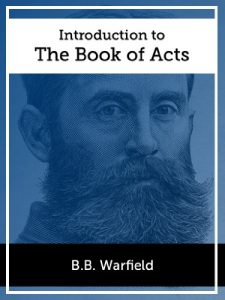
Benjamin B. Warfield (1851-1921), the last of the great Princeton theologians, was professor of theology at Princeton from 1887 until his death.
"It is the purpose of this article," the great Presbyterian begins, "to give as clear a view as possible of the process by which the Westminster Confession was made. In prosecuting this purpose two tasks present themselves. One concerns the modes of procedure of the Assembly in framing the Confession; the other the course of the debates by which it was beaten out. We shall attempt to give some account of both matters. The latter offers so wide a field, however, that we shall be constrained to deal with it by sample - and, for reasons which will readily suggest themselves at the present juncture, we shall select the third chapter of the Confession as the sample to be dealt with. We shall therefore try first to trace the formal procedure of the Assembly in framing the whole Confession, and to obtain some adequate conception of the labor and time that was expended on it; and then, taking up the third chapter, we shall essay to reconstruct as fully as may be a picture of the actual work of the Assembly in producing it."
"It is the purpose of this article," the great Presbyterian begins, "to give as clear a view as possible of the process by which the Westminster Confession was made. In prosecuting this purpose two tasks present themselves. One concerns the modes of procedure of the Assembly in framing the Confession; the other the course of the debates by which it was beaten out. We shall attempt to give some account of both matters. The latter offers so wide a field, however, that we shall be constrained to deal with it by sample - and, for reasons which will readily suggest themselves at the present juncture, we shall select the third chapter of the Confession as the sample to be dealt with. We shall therefore try first to trace the formal procedure of the Assembly in framing the whole Confession, and to obtain some adequate conception of the labor and time that was expended on it; and then, taking up the third chapter, we shall essay to reconstruct as fully as may be a picture of the actual work of the Assembly in producing it."