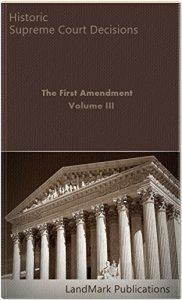
THIS CASEBOOK is Volume III of a three part series that contains selected historic Supreme Court decisions which interpret provisions of the First Amendment. This volume covers the Free Exercise Clause and the Establishment Clause. Volume I covers freedom of speech. Volume II covers freedom of the press, freedom of assembly, freedom of association, flag desecration, symbolic speech, commercial speech, obscenity and political speech.
The First Amendment provides that "Congress shall make no law respecting an establishment of religion, or prohibiting the free exercise thereof . . ."
[F]or the men who wrote the Religion Clauses of the First Amendment the "establishment" of a religion connoted sponsorship, financial support, and active involvement of the sovereign in religious activity. In England, and in some Colonies at the time of the separation in 1776, the Church of England was sponsored and supported by the Crown as a state, or established, church; in other countries "establishment" meant sponsorship by the sovereign of the Lutheran or Catholic Church. See Engel v. Vitale, 370 U. S., at 428 n. 10. See generally C. Antieau, A. Downey, & E. Roberts, Freedom from Federal Establishment (1964). The exclusivity of established churches in the 17th and 18th centuries, of course, was often carried to prohibition of other forms of worship. See Everson v. Board of Education, 330 U. S., at 9-11; L. Pfeffer, Church, State and Freedom 71 et seq. (1967). Walz v. Tax Comm'n of City of New York, 397 US 664 (1970).
The Establishment and Free Exercise Clauses of the First Amendment are not the most precisely drawn portions of the Constitution. The sweep of the absolute prohibitions in the Religion Clauses may have been calculated; but the purpose was to state an objective, not to write a statute. In attempting to articulate the scope of the two Religion Clauses, the Court's opinions reflect the limitations inherent in formulating general principles on a case-by-case basis. The considerable internal inconsistency in the opinions of the Court derives from what, in retrospect, may have been too sweeping utterance on aspects of these clauses that seemed clear in relation to the particular cases but have limited meaning as general principles. Walz v. Tax Comm'n of City of New York, ibid..
The language of the Religion Clauses of the First Amendment is at best opaque, particularly when compared with other portions of the Amendment. Its authors did not simply prohibit the establishment of a state church or a state religion, an area history shows they regarded as very important and fraught with great dangers. Instead they commanded that there should be "no law respecting an establishment of religion." A law may be one "respecting" the forbidden objective while falling short of its total realization. A law "respecting" the proscribed result, that is, the establishment of religion, is not always easily identifiable as one violative of the Clause. A given law might not establish a state religion but nevertheless be one "respecting" that end in the sense of being a step that could lead to such establishment and hence offend the First Amendment. Lemon v. Kurtzman, 403 US 602 (1971).
In the absence of precisely stated constitutional prohibitions, we must draw lines with reference to the three main evils against which the Establishment Clause was intended to afford protection: "sponsorship, financial support, and active involvement of the sovereign in religious activity." Walz v. Tax Commission, 397 U. S. 664, 668 (1970). Lemon v. Kurtzman, ibid.
The First Amendment provides that "Congress shall make no law respecting an establishment of religion, or prohibiting the free exercise thereof . . ."
[F]or the men who wrote the Religion Clauses of the First Amendment the "establishment" of a religion connoted sponsorship, financial support, and active involvement of the sovereign in religious activity. In England, and in some Colonies at the time of the separation in 1776, the Church of England was sponsored and supported by the Crown as a state, or established, church; in other countries "establishment" meant sponsorship by the sovereign of the Lutheran or Catholic Church. See Engel v. Vitale, 370 U. S., at 428 n. 10. See generally C. Antieau, A. Downey, & E. Roberts, Freedom from Federal Establishment (1964). The exclusivity of established churches in the 17th and 18th centuries, of course, was often carried to prohibition of other forms of worship. See Everson v. Board of Education, 330 U. S., at 9-11; L. Pfeffer, Church, State and Freedom 71 et seq. (1967). Walz v. Tax Comm'n of City of New York, 397 US 664 (1970).
The Establishment and Free Exercise Clauses of the First Amendment are not the most precisely drawn portions of the Constitution. The sweep of the absolute prohibitions in the Religion Clauses may have been calculated; but the purpose was to state an objective, not to write a statute. In attempting to articulate the scope of the two Religion Clauses, the Court's opinions reflect the limitations inherent in formulating general principles on a case-by-case basis. The considerable internal inconsistency in the opinions of the Court derives from what, in retrospect, may have been too sweeping utterance on aspects of these clauses that seemed clear in relation to the particular cases but have limited meaning as general principles. Walz v. Tax Comm'n of City of New York, ibid..
The language of the Religion Clauses of the First Amendment is at best opaque, particularly when compared with other portions of the Amendment. Its authors did not simply prohibit the establishment of a state church or a state religion, an area history shows they regarded as very important and fraught with great dangers. Instead they commanded that there should be "no law respecting an establishment of religion." A law may be one "respecting" the forbidden objective while falling short of its total realization. A law "respecting" the proscribed result, that is, the establishment of religion, is not always easily identifiable as one violative of the Clause. A given law might not establish a state religion but nevertheless be one "respecting" that end in the sense of being a step that could lead to such establishment and hence offend the First Amendment. Lemon v. Kurtzman, 403 US 602 (1971).
In the absence of precisely stated constitutional prohibitions, we must draw lines with reference to the three main evils against which the Establishment Clause was intended to afford protection: "sponsorship, financial support, and active involvement of the sovereign in religious activity." Walz v. Tax Commission, 397 U. S. 664, 668 (1970). Lemon v. Kurtzman, ibid.