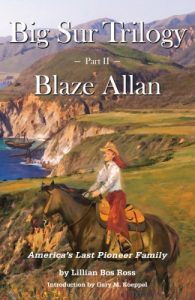
The Big Sur Trilogy is the story about one of the last pioneer families in America who lived freely and self-sufficiently in a remote area of the central California coast once called El Sur de la Grande, or the Big South, now known simply as the Big Sur. The Trilogy spans over 100 years and depicts the hard but rewarding life of three generations of the Zande Allan family.
The Big Sur Coast extends 100 miles from Carmel to San Simeon and is bordered by the Santa Lucia Mountains and Pacific Ocean. This remote wilderness contains some of the most rugged terrain in the American continent. From the beginning of time the south coast was accessible only by foot, mule or horseback. Although inhabited by three nomadic American Indian tribes, the Spaniards refused to travel along the coast because of the high mountains, steep canyons and dangerous water crossings.
In the 1870s a partial wagon road was built from Mal Paso Crossing to Bixby Creek Ranch. The next 74 miles of the Big Sur Coast was not accessible by auto until 1937 with the opening of Highway One, which took eighteen years to build, mostly by convict labor using dynamite and steam shovels.
When completed, it became the only road in the United States that went directly from a horse trail to an auto road, thus bypassing the traditional, interim wagon road. The road changed forever the lives of the Big Sur homesteaders as the mainstream modern American culture motored into their once-private coast.
Before the road, few ‘outlanders’ visited the south coast because travel was strenuous, the trail precarious and the homesteads were few and far between, but those who ventured there were greeted with coast hospitality, lively conversation and ranch grown food.
The Big Sur pioneer families worked long hours and full days with little time for frills or fancy things, and they had no patience for what was not plain spoken. A trip to Monterey to buy supplies or to Salinas to sell cattle took three hard days by horseback along narrow trails at the edge of granite cliffs often falling straight to the sea some 2000 feet below. Twice a year the ranchers would gather for a coast barbecue with neighbors on the beach while waiting for the cargo schooner to arrive and winch ashore their load of hard stock supplies too bulky for pack mule or horse.
The second novel is named after one of Zande and Hannah’s twin children, Blaze Allan, who took her stubborn likenesses from her father and her tender feelings and love for natural things from her mother.
She could sit a saddle as good as any man on the coast, but she was a sensitive and beautiful woman. But when father Zande sternly informed her about his plans to marry her off to a young man not to her liking, she rebelled against his wishes. One day she met a stranger on the trail, a tan bark stripper. She fell in love with this passing stranger and dreamed about him as she struggled against her father’s plan to marry a man she despised.
A young Spaniard, Pete Garcia, teased Blaze into fetching Abalone in a remote cove on rocky beach, but once there, his interest quickly changed from Abalone to Amore. As a proper coast girl who was not about to lose her reputation, she rejected his advances. But as the tide came in they became trapped in the cove, which would cause a forbidden overnight stay. Knowing the coast folks would assume the worst and gossip about her, against Blazes’ wishes, Pete tried swimming for help, but he drowned in the powerful surf.
Although still pure and innocent, during Pete’s funeral her father and neighbors shunned her as a ruined woman and blamed her for Pete’s death, then her rejected suitor spread the false rumor that they had been together, further tarnishing her reputation.
Devastated by their harsh and unfair judgment, she fled from the funeral to escape to Monterey when, once again, on the trail she came upon the stranger, who arranged for passage to Monterey on his tanbark cargo schooner.
The Big Sur Coast extends 100 miles from Carmel to San Simeon and is bordered by the Santa Lucia Mountains and Pacific Ocean. This remote wilderness contains some of the most rugged terrain in the American continent. From the beginning of time the south coast was accessible only by foot, mule or horseback. Although inhabited by three nomadic American Indian tribes, the Spaniards refused to travel along the coast because of the high mountains, steep canyons and dangerous water crossings.
In the 1870s a partial wagon road was built from Mal Paso Crossing to Bixby Creek Ranch. The next 74 miles of the Big Sur Coast was not accessible by auto until 1937 with the opening of Highway One, which took eighteen years to build, mostly by convict labor using dynamite and steam shovels.
When completed, it became the only road in the United States that went directly from a horse trail to an auto road, thus bypassing the traditional, interim wagon road. The road changed forever the lives of the Big Sur homesteaders as the mainstream modern American culture motored into their once-private coast.
Before the road, few ‘outlanders’ visited the south coast because travel was strenuous, the trail precarious and the homesteads were few and far between, but those who ventured there were greeted with coast hospitality, lively conversation and ranch grown food.
The Big Sur pioneer families worked long hours and full days with little time for frills or fancy things, and they had no patience for what was not plain spoken. A trip to Monterey to buy supplies or to Salinas to sell cattle took three hard days by horseback along narrow trails at the edge of granite cliffs often falling straight to the sea some 2000 feet below. Twice a year the ranchers would gather for a coast barbecue with neighbors on the beach while waiting for the cargo schooner to arrive and winch ashore their load of hard stock supplies too bulky for pack mule or horse.
The second novel is named after one of Zande and Hannah’s twin children, Blaze Allan, who took her stubborn likenesses from her father and her tender feelings and love for natural things from her mother.
She could sit a saddle as good as any man on the coast, but she was a sensitive and beautiful woman. But when father Zande sternly informed her about his plans to marry her off to a young man not to her liking, she rebelled against his wishes. One day she met a stranger on the trail, a tan bark stripper. She fell in love with this passing stranger and dreamed about him as she struggled against her father’s plan to marry a man she despised.
A young Spaniard, Pete Garcia, teased Blaze into fetching Abalone in a remote cove on rocky beach, but once there, his interest quickly changed from Abalone to Amore. As a proper coast girl who was not about to lose her reputation, she rejected his advances. But as the tide came in they became trapped in the cove, which would cause a forbidden overnight stay. Knowing the coast folks would assume the worst and gossip about her, against Blazes’ wishes, Pete tried swimming for help, but he drowned in the powerful surf.
Although still pure and innocent, during Pete’s funeral her father and neighbors shunned her as a ruined woman and blamed her for Pete’s death, then her rejected suitor spread the false rumor that they had been together, further tarnishing her reputation.
Devastated by their harsh and unfair judgment, she fled from the funeral to escape to Monterey when, once again, on the trail she came upon the stranger, who arranged for passage to Monterey on his tanbark cargo schooner.