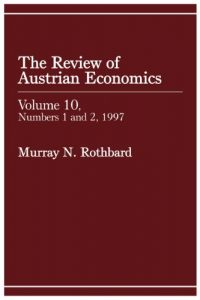
RAE VOLUME 10
Murray Rothbard had long dreamed of an Austrian academic journal. In 1986, his dream came true. The Mises Institute published it, and it changed everything. The Austrians could focus on internal development, highlight the contrast with the mainstream, and show their wares to the profession and the world at large.
Rothbard was an exacting editor, and results are spectacular and historic.
The individual issues have been nearly impossible to find, until now. Today you can own the entire set, learn from the pioneering articles that Murray and his co-editors saw as crucial, and see what gave the modern Austrian movement its scholarly momentum.
I. Articles
Randall G. Holcombe
1. A Theory of the Theory of Public Goods
Jörg Guido Hülsmann
2. Knowledge, Judgment, and the Use of Property
Hans-Hermann Hoppe
3. On Certainty and Uncertainty, Or: How Rational Can Our Expectations Be?
Jeffrey M. Herbener
4. The Pareto Rule and Welfare Economics
Arthur Middleton Hughes
5. The Recession of 1990: An Austrian Explanation
II. Notes and Replies
Ivan Pongracic
6. How Different Were Röpke and Mises?
Leland B. Yeager
7. Calculation and Knowledge: Let’s Write Finis
III. Book Reviews
8. Frank M. Machovec, Perfect Competition and the Transformation of Economics Reviewed by William D. Curl
9. Paul Krugman, Pop Internationalism Reviewed by David Gordon
10. Robert Skidelsky, The Road From Serfdom: The Economic and Political Consequences of the End of Communism Reviewed by David Gordon
I. Articles
Parth Shah
1. The Option Clause in Free-Banking Theory and History: A Reappraisal
Frank Shostak
2. In Defense of Fundamental Analysis: A Critique of the Efficient Market Hypothesis
Jacqueline R. Kasun
3. Government Family Planning: Effects and Incentives
II. Notes and Replies
Richard Vedder
4. Statistical Malfeasance and Interpreting Economic Phenomena
Lowell Gallaway
5. Some Austrian Perspectives on Unintended Consequences
Harold Demsetz
6. Block’s Erroneous Interpretations
Yuri Kuznetsov
7. Fiat Money as an Administrative Good
III. Book Reviews
8. George Reisman, Capitalism: A Complete and Integrated Understanding of the Nature and Value of Human Economic Life Reviewed by Alexander Tabarrok
Murray Rothbard had long dreamed of an Austrian academic journal. In 1986, his dream came true. The Mises Institute published it, and it changed everything. The Austrians could focus on internal development, highlight the contrast with the mainstream, and show their wares to the profession and the world at large.
Rothbard was an exacting editor, and results are spectacular and historic.
The individual issues have been nearly impossible to find, until now. Today you can own the entire set, learn from the pioneering articles that Murray and his co-editors saw as crucial, and see what gave the modern Austrian movement its scholarly momentum.
I. Articles
Randall G. Holcombe
1. A Theory of the Theory of Public Goods
Jörg Guido Hülsmann
2. Knowledge, Judgment, and the Use of Property
Hans-Hermann Hoppe
3. On Certainty and Uncertainty, Or: How Rational Can Our Expectations Be?
Jeffrey M. Herbener
4. The Pareto Rule and Welfare Economics
Arthur Middleton Hughes
5. The Recession of 1990: An Austrian Explanation
II. Notes and Replies
Ivan Pongracic
6. How Different Were Röpke and Mises?
Leland B. Yeager
7. Calculation and Knowledge: Let’s Write Finis
III. Book Reviews
8. Frank M. Machovec, Perfect Competition and the Transformation of Economics Reviewed by William D. Curl
9. Paul Krugman, Pop Internationalism Reviewed by David Gordon
10. Robert Skidelsky, The Road From Serfdom: The Economic and Political Consequences of the End of Communism Reviewed by David Gordon
I. Articles
Parth Shah
1. The Option Clause in Free-Banking Theory and History: A Reappraisal
Frank Shostak
2. In Defense of Fundamental Analysis: A Critique of the Efficient Market Hypothesis
Jacqueline R. Kasun
3. Government Family Planning: Effects and Incentives
II. Notes and Replies
Richard Vedder
4. Statistical Malfeasance and Interpreting Economic Phenomena
Lowell Gallaway
5. Some Austrian Perspectives on Unintended Consequences
Harold Demsetz
6. Block’s Erroneous Interpretations
Yuri Kuznetsov
7. Fiat Money as an Administrative Good
III. Book Reviews
8. George Reisman, Capitalism: A Complete and Integrated Understanding of the Nature and Value of Human Economic Life Reviewed by Alexander Tabarrok