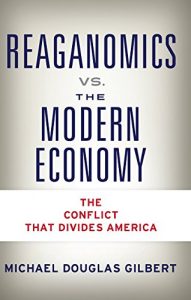
Reaganomics vs The Modern Economy: The Conflict that Divides America defines the modern economy, contrasts it with the primitive economy that preceded it, and describes how neglect of the proper role of government leads to inadequate employment, unmet needs, and diminished economic activity. Part I categorizes the five functions of government and shows how natural anti-government bias makes many voters susceptible to policies that cause them economic harm.
Part IV describes how spending on consumption, investment, and public services can affect employment in very different ways. We show that, in a well defined manner, public sector spending gives rise to more employment per tax dollar spent than private sector alternatives. After reviewing recent research in income and wealth distribution, we see that policies that favor maldistribution can also diminish employment. In order for most Americans to survive and prosper, it is necessary that the modern economy include both markets and government.
Part II describes the history of resistance to government in America and the frustrations in the Republican Party going back to the 1930's that led to the election of Ronald Reagan in 1980. Reaganomics has dominated public policy since then, largely because of Reagan's personal popularity and the mistaken notion that his policies turned the economy around.
Market forces in the oil industry ended the worldwide stagflation that devastated the US economy in the 1970's and 1980's; but few people understood the long term nature of this correction. The resulting confusion and political self interest led to decades of bad public policy. Reaganomics had nothing to do with the improvements in the American economy in the 1980's, but lucky timing allowed Reagan to get credit.
As an attempt to defy the clear requirements of our modern economy, Reaganomics has always failed as an economic policy. Part III describes how Reaganomics has been used successfully as an political strategy, and this has resulted in decades of poor economic policy, a dysfunctional Congress, and considerable dissension and frustration in the country.
People in a modern economy encounter both market deficiencies and market efficiency. The former gives rise to the five categories of government functions described in chapter 1. But some people invoke Reaganomics and oppose the use of government for just about anything. At the same time, the private sector is always trying to minimize labor costs in the name of efficiency. Together, these two factors reduce employment, consumption, demand, business activity, and investment opportunities. At what point does the market economy become unworkable? Are we there yet? Currently, most Americans are struggling. Can we determine the combination of government minimization and market efficiency that will lead to revolution?
Since 1968, Michael Gilbert's main interests in economics have been in the related areas of human survival in a modern economy, and in the relationship between the private sector and government. He is the author of America in the Economic World: Jobs, Necessities, and Economic Optimization (2014).
After earning degrees in mathematics, Michael worked for decades as an exploration geophysicist on successful projects in North and South America. He retired in 2003 as the Chief Geophysicist for an independent oil company. Over the years, he has trained geophysicists and taught college and community college mathematics as well as federal income tax preparation. Since 2010, he has followed his life long interests to work exclusively on research and writing in economics and political economy.
Michael is an emeritus member of both the American Mathematical Society and the Mathematical Association of America. He is also a member of Beta Gamma Sigma, the national business honor society.
Part IV describes how spending on consumption, investment, and public services can affect employment in very different ways. We show that, in a well defined manner, public sector spending gives rise to more employment per tax dollar spent than private sector alternatives. After reviewing recent research in income and wealth distribution, we see that policies that favor maldistribution can also diminish employment. In order for most Americans to survive and prosper, it is necessary that the modern economy include both markets and government.
Part II describes the history of resistance to government in America and the frustrations in the Republican Party going back to the 1930's that led to the election of Ronald Reagan in 1980. Reaganomics has dominated public policy since then, largely because of Reagan's personal popularity and the mistaken notion that his policies turned the economy around.
Market forces in the oil industry ended the worldwide stagflation that devastated the US economy in the 1970's and 1980's; but few people understood the long term nature of this correction. The resulting confusion and political self interest led to decades of bad public policy. Reaganomics had nothing to do with the improvements in the American economy in the 1980's, but lucky timing allowed Reagan to get credit.
As an attempt to defy the clear requirements of our modern economy, Reaganomics has always failed as an economic policy. Part III describes how Reaganomics has been used successfully as an political strategy, and this has resulted in decades of poor economic policy, a dysfunctional Congress, and considerable dissension and frustration in the country.
People in a modern economy encounter both market deficiencies and market efficiency. The former gives rise to the five categories of government functions described in chapter 1. But some people invoke Reaganomics and oppose the use of government for just about anything. At the same time, the private sector is always trying to minimize labor costs in the name of efficiency. Together, these two factors reduce employment, consumption, demand, business activity, and investment opportunities. At what point does the market economy become unworkable? Are we there yet? Currently, most Americans are struggling. Can we determine the combination of government minimization and market efficiency that will lead to revolution?
Since 1968, Michael Gilbert's main interests in economics have been in the related areas of human survival in a modern economy, and in the relationship between the private sector and government. He is the author of America in the Economic World: Jobs, Necessities, and Economic Optimization (2014).
After earning degrees in mathematics, Michael worked for decades as an exploration geophysicist on successful projects in North and South America. He retired in 2003 as the Chief Geophysicist for an independent oil company. Over the years, he has trained geophysicists and taught college and community college mathematics as well as federal income tax preparation. Since 2010, he has followed his life long interests to work exclusively on research and writing in economics and political economy.
Michael is an emeritus member of both the American Mathematical Society and the Mathematical Association of America. He is also a member of Beta Gamma Sigma, the national business honor society.