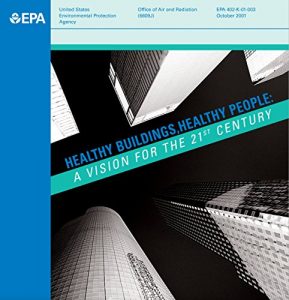
The U.S. Environmental Protection Agency (EPA) is pleased to issue the Healthy
Buildings, Healthy People (HBHP) report, a vision for indoor environmental
quality in the 21st Century. The importance of the indoor environment to human
health has been highlighted in numerous environmental risk reports, including
the 1997 report of the Presidential and Congressional Commission on Risk
Assessment and Risk Management. On average, we spend about 90 percent of
our time indoors, where pollutant levels are often higher than those outside.
Indoor pollution is estimated to cause thousands of cancer deaths and hundreds
of thousands of respiratory health problems each year. In addition, hundreds of
thousands of children have experienced elevated blood lead levels resulting from
their exposure to indoor pollutants.
The report challenges all of us to work together to improve the quality of our
environment. It can also serve as the basis for discussion and education among
professionals in public policy, health, building sciences, product manufacturing,
and environmental research. The report is also a blueprint for channeling available
resources. Already, EPA has undertaken program initiatives focusing on
childhood asthma, characterizing the effect of building and consumer
products on the indoor environment, increasing the demand for cleaner indoor
products for use in schools, creating standards of care for existing buildings, and
designing guidance for new schools. EPA is also integrating good indoor environmental
quality (IEQ) concepts into the Energy Star® label program for commercial
office buildings. Moreover, other current federal programs, while not
direct outgrowths of the HBHP effort, are complementary of it. For example, at
the Department of Housing and Urban Development (HUD), the Healthy
Homes project has identified moisture and molds as a priority to be addressed in
its grants process, and the Healthy People 2010 effort at the Department of
Health and Human Services (DHHS) contains several goals relating to IEQ
progress in existing buildings.We challenge others, including government, tribes,
the health community, academia, non-profit organizations, and industry, to
embrace the HBHP goals and work together to invest in the actions outlined in
the report. In this way, we can begin to make progress towards realizing the
vision of HBHP.
The HBHP report is the outcome of a cross-Agency effort to define a strategic
vision and potential actions for improving the quality of our indoor environment
and was jointly led by the Office of Air and Radiation (OAR) and the Office of
Prevention, Pesticides, and Toxic Substances (OPPTS) with substantial involvement
from the Office of Research and Development (ORD). As part of this
effort, we sought the advice of many outside experts and visionaries.
Buildings, Healthy People (HBHP) report, a vision for indoor environmental
quality in the 21st Century. The importance of the indoor environment to human
health has been highlighted in numerous environmental risk reports, including
the 1997 report of the Presidential and Congressional Commission on Risk
Assessment and Risk Management. On average, we spend about 90 percent of
our time indoors, where pollutant levels are often higher than those outside.
Indoor pollution is estimated to cause thousands of cancer deaths and hundreds
of thousands of respiratory health problems each year. In addition, hundreds of
thousands of children have experienced elevated blood lead levels resulting from
their exposure to indoor pollutants.
The report challenges all of us to work together to improve the quality of our
environment. It can also serve as the basis for discussion and education among
professionals in public policy, health, building sciences, product manufacturing,
and environmental research. The report is also a blueprint for channeling available
resources. Already, EPA has undertaken program initiatives focusing on
childhood asthma, characterizing the effect of building and consumer
products on the indoor environment, increasing the demand for cleaner indoor
products for use in schools, creating standards of care for existing buildings, and
designing guidance for new schools. EPA is also integrating good indoor environmental
quality (IEQ) concepts into the Energy Star® label program for commercial
office buildings. Moreover, other current federal programs, while not
direct outgrowths of the HBHP effort, are complementary of it. For example, at
the Department of Housing and Urban Development (HUD), the Healthy
Homes project has identified moisture and molds as a priority to be addressed in
its grants process, and the Healthy People 2010 effort at the Department of
Health and Human Services (DHHS) contains several goals relating to IEQ
progress in existing buildings.We challenge others, including government, tribes,
the health community, academia, non-profit organizations, and industry, to
embrace the HBHP goals and work together to invest in the actions outlined in
the report. In this way, we can begin to make progress towards realizing the
vision of HBHP.
The HBHP report is the outcome of a cross-Agency effort to define a strategic
vision and potential actions for improving the quality of our indoor environment
and was jointly led by the Office of Air and Radiation (OAR) and the Office of
Prevention, Pesticides, and Toxic Substances (OPPTS) with substantial involvement
from the Office of Research and Development (ORD). As part of this
effort, we sought the advice of many outside experts and visionaries.