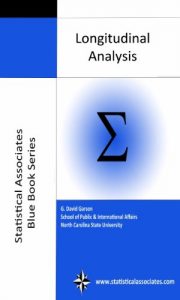
An introductory graduate level text on longitudinal analysis using SPSS, SAS, and Stata.
328 pages
Longitudinal analysis is an umbrella term for a variety of statistical procedures which deal with any type of data which is measured over time. Sections of this volume group longitudinal analysis methods under the following categories:
Time series analysis, often used for projecting economic or other time series, with or without additional independent variables. Includes ARIMA models.
Linear regression models, which incorporate time as an independent variable.
Panel data regression models,
Repeated measures GLM, used to implement analysis of variance and regression models.
General estimating equations analysis (GEE), used to implement nonlinear forms of regression modeling, including logistic and probit regression for repeated measures data.
Linear mixed modeling (LMM), used for multilevel analysis where multiple time periods are treated as a data level.
Generalized linear mixed models for longitudinal data (GLMM), used to implement nonlinear forms of linear mixed modeling
Structural equation modeling (SEM), used for growth curve analysis and modeling change in structural relationships across a limited number of time periods.
Overview13
Comparing time series procedures13
GLM (OLS regression or ANOVA) with time as a variable13
Time series analysis (ex., ARIMA14
Repeated measures GLM14
Generalized estimating equations (GEE)14
Population-averaged panel data regression14
Random effects panel data regression15
Linear mixed models (LMM)15
Generalized linear mixed models (GLMM)15
Structural equation modeling15
GLMM-SEM15
Key concepts and terms16
Types of time-related data16
Statistical procedures for different types of data collected over time18
Time series analysis19
Overview19
Key Terms and Concepts19
Simple time series design20
Time series effects20
Serial dependence20
Stationarity20
Differencing21
Specification21
Autocorrelation21
Decomposition22
Model order22
Exponential Smoothing23
Overview23
Weighting23
Example24
Sequence charts24
Requesting exponential smoothing in SPSS26
Exponential smoothing model types: Simple27
Exponential smoothing model types: Holt's linear trend30
Exponential smoothing model types: Brown's linear trend31
Exponential smoothing model types: Damped trend32
Exponential smoothing model types: Seasonal effects32
Transformation of the dependent variable33
Statistical output for time series analysis in SPSS33
Residual and partial residual autocorrelation36
Displaying forecast values37
Saving exponential smoothing values in SPSS38
ARIMA Models40
Overview40
Example40
Constants and predictors41
Stationarity41
ARIMA p, d, and q parameters46
Types of ARIMA models50
Unit roots52
ARIMA for the example data52
Forecasts54
Residual Analysis55
Seasonal ARIMA61
ARIMA Modeling: Intervention and transfer function analysis62
The SPSS "Expert Modeler"68
Overview68
The “Expert Modeler” interface68
Leading indicator (CCF) analysis71
Overview71
SPSS set-up71
CCF output72
Creating a leading indicator variable74
Assumptions of time series analysis75
Stationarity75
Normally distributed independent residuals with homogenous variance76
Inconsequential outliers76
Frequently asked questions about time series analysis76
How many time periods are needed?76
What should the researcher do about missing data?76
When I try to specify p, d, and q for an ARIMA model, should non-significant spikes be treated as zero?77
I suspect there is not a single trend line but rather the trend is different for different subgroups in my population. How do I handle this?77
How does one go about disentangling age, period, and cohort time series effects?79
Is there an acceptable ARIMA model for all data?79
What is an ARFIMA model?80
Regression time series models80
Curve fitting80
Curve Estimation dialog in SPSS80
and 248 more pages of topics.
328 pages
Longitudinal analysis is an umbrella term for a variety of statistical procedures which deal with any type of data which is measured over time. Sections of this volume group longitudinal analysis methods under the following categories:
Time series analysis, often used for projecting economic or other time series, with or without additional independent variables. Includes ARIMA models.
Linear regression models, which incorporate time as an independent variable.
Panel data regression models,
Repeated measures GLM, used to implement analysis of variance and regression models.
General estimating equations analysis (GEE), used to implement nonlinear forms of regression modeling, including logistic and probit regression for repeated measures data.
Linear mixed modeling (LMM), used for multilevel analysis where multiple time periods are treated as a data level.
Generalized linear mixed models for longitudinal data (GLMM), used to implement nonlinear forms of linear mixed modeling
Structural equation modeling (SEM), used for growth curve analysis and modeling change in structural relationships across a limited number of time periods.
Overview13
Comparing time series procedures13
GLM (OLS regression or ANOVA) with time as a variable13
Time series analysis (ex., ARIMA14
Repeated measures GLM14
Generalized estimating equations (GEE)14
Population-averaged panel data regression14
Random effects panel data regression15
Linear mixed models (LMM)15
Generalized linear mixed models (GLMM)15
Structural equation modeling15
GLMM-SEM15
Key concepts and terms16
Types of time-related data16
Statistical procedures for different types of data collected over time18
Time series analysis19
Overview19
Key Terms and Concepts19
Simple time series design20
Time series effects20
Serial dependence20
Stationarity20
Differencing21
Specification21
Autocorrelation21
Decomposition22
Model order22
Exponential Smoothing23
Overview23
Weighting23
Example24
Sequence charts24
Requesting exponential smoothing in SPSS26
Exponential smoothing model types: Simple27
Exponential smoothing model types: Holt's linear trend30
Exponential smoothing model types: Brown's linear trend31
Exponential smoothing model types: Damped trend32
Exponential smoothing model types: Seasonal effects32
Transformation of the dependent variable33
Statistical output for time series analysis in SPSS33
Residual and partial residual autocorrelation36
Displaying forecast values37
Saving exponential smoothing values in SPSS38
ARIMA Models40
Overview40
Example40
Constants and predictors41
Stationarity41
ARIMA p, d, and q parameters46
Types of ARIMA models50
Unit roots52
ARIMA for the example data52
Forecasts54
Residual Analysis55
Seasonal ARIMA61
ARIMA Modeling: Intervention and transfer function analysis62
The SPSS "Expert Modeler"68
Overview68
The “Expert Modeler” interface68
Leading indicator (CCF) analysis71
Overview71
SPSS set-up71
CCF output72
Creating a leading indicator variable74
Assumptions of time series analysis75
Stationarity75
Normally distributed independent residuals with homogenous variance76
Inconsequential outliers76
Frequently asked questions about time series analysis76
How many time periods are needed?76
What should the researcher do about missing data?76
When I try to specify p, d, and q for an ARIMA model, should non-significant spikes be treated as zero?77
I suspect there is not a single trend line but rather the trend is different for different subgroups in my population. How do I handle this?77
How does one go about disentangling age, period, and cohort time series effects?79
Is there an acceptable ARIMA model for all data?79
What is an ARFIMA model?80
Regression time series models80
Curve fitting80
Curve Estimation dialog in SPSS80
and 248 more pages of topics.