". . . the four hunters dashed boldly towards the terrified savages, who in turn fled, with greater velocity than they had called into exercise at any time during their advance,—illustrating the truth of the saying, "tyrants are always cowards. . . ."
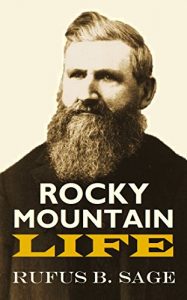
Rufus B. Sage (1817–1893) was an American writer, journalist and mountain man. He is best known as the author of "Rocky Mountain Life" first published in 1846, depicting the life of fur trappers.
After the struggles of political campaign to elect Henry Harrison as president, his attention was again drawn to the unknown – so little was known about the territories between Missouri and the Pacific Ocean. Incited by a strong desire to explore the vast region beyond the Missouri frontier, Sage organized a party to explore the west. Despite the fact that his party was scarce, Sage ventured onwards and later joined a party of Indian traders. This period was later described in his famous recollections entitled Rocky Mountain Life.
The book provides an illustrated account of life in the west as it was before the rush to California. Naturally it deals to a great extent with the habits, characteristics and customs of the Indians of different tribes. It describes the country in detail.
Sage writes:
"MY purpose in visiting the Rocky Mountains, and countries adjacent, having hitherto proved a fruitful source of inquiry to the many persons I meet, when aware of my having devoted three years to travel in those remote regions. 'Why did I go?—what was my object?' Let me explain: Dame Nature bestowed upon me lavishly that innate curiosity, and fondness for things strange and new, of which every one is more or less possessed. l have a great liking to tread upon unfrequented ground, and mingle among scenes at once novel and romantic. Love of adventure, then, was the great prompter."
In describing a mysterious tribe of white skinned Indians, Sage writes:
"“. . . The Munchies are a nation of white aborigines, actually existing in a valley among the Sierra de los Mimbros chain, ... their features correspond with those of Europeans, though with a complexion, perhaps, somewhat fairer. . . .”
Sage also relates a version of the story of Hugh Glass the famous grizzly-mauled mountain man, concluding:
"He still lives in the town of Taos, New Mexico, and frequently repeats to wondering listeners the particulars of this terrific and painful adventure."
Interestingly, Sage also happens to meet Fitzgerald (the trapper who had abandoned the wounded Glass in the wilderness), stating:
"Fitzpatrick and Van Dusen, two old mountaineers, passed our en campment, in the interim, on their way to the States. Having devoted a number of years to the business of trapping, few possess a more intimate knowledge of this country than they. . . ."
In describing a battle with a wolf, Sage writes:
". . . On one occasion a strolling wolf, venturing too near camp, received the contents of my rifle and instantly fell. Supposing the shot to be a fatal one, I advanced and seized him by the tail with the design of taking his skin. But the creature, having been only stunned by a neck wound, now revived in full strength, and, enraged at his rough treatment, called into exercise the utmost tension of his energies to afford a bitter sample of the fierceness of wolfine vengeance . . . . "
Rufus B. Sage (1817–1893) was an American writer, journalist and mountain man. He is best known as the author of "Rocky Mountain Life" first published in 1846, depicting the life of fur trappers.
After the struggles of political campaign to elect Henry Harrison as president, his attention was again drawn to the unknown – so little was known about the territories between Missouri and the Pacific Ocean. Incited by a strong desire to explore the vast region beyond the Missouri frontier, Sage organized a party to explore the west. Despite the fact that his party was scarce, Sage ventured onwards and later joined a party of Indian traders. This period was later described in his famous recollections entitled Rocky Mountain Life.
The book provides an illustrated account of life in the west as it was before the rush to California. Naturally it deals to a great extent with the habits, characteristics and customs of the Indians of different tribes. It describes the country in detail.
Sage writes:
"MY purpose in visiting the Rocky Mountains, and countries adjacent, having hitherto proved a fruitful source of inquiry to the many persons I meet, when aware of my having devoted three years to travel in those remote regions. 'Why did I go?—what was my object?' Let me explain: Dame Nature bestowed upon me lavishly that innate curiosity, and fondness for things strange and new, of which every one is more or less possessed. l have a great liking to tread upon unfrequented ground, and mingle among scenes at once novel and romantic. Love of adventure, then, was the great prompter."
In describing a mysterious tribe of white skinned Indians, Sage writes:
"“. . . The Munchies are a nation of white aborigines, actually existing in a valley among the Sierra de los Mimbros chain, ... their features correspond with those of Europeans, though with a complexion, perhaps, somewhat fairer. . . .”
Sage also relates a version of the story of Hugh Glass the famous grizzly-mauled mountain man, concluding:
"He still lives in the town of Taos, New Mexico, and frequently repeats to wondering listeners the particulars of this terrific and painful adventure."
Interestingly, Sage also happens to meet Fitzgerald (the trapper who had abandoned the wounded Glass in the wilderness), stating:
"Fitzpatrick and Van Dusen, two old mountaineers, passed our en campment, in the interim, on their way to the States. Having devoted a number of years to the business of trapping, few possess a more intimate knowledge of this country than they. . . ."
In describing a battle with a wolf, Sage writes:
". . . On one occasion a strolling wolf, venturing too near camp, received the contents of my rifle and instantly fell. Supposing the shot to be a fatal one, I advanced and seized him by the tail with the design of taking his skin. But the creature, having been only stunned by a neck wound, now revived in full strength, and, enraged at his rough treatment, called into exercise the utmost tension of his energies to afford a bitter sample of the fierceness of wolfine vengeance . . . . "