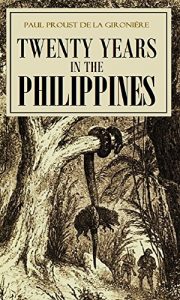
Paul Proust de la Gironière (1797–1862) was a traveler from Nantes who lived in the Philippines and wrote about his experiences there. He arrived in the Philippines in 1820 and became "King Paul", founder of the colony of Jala-Jala, and ruler of the tribes of Tagaloc. King Paul was, on the whole, successful with his colony in Morong (present-day Rizal province). In 1853 Frederick Hardman (1814–1874) translated into English, Gironière's book of adventures "Twenty years in the
Philippines."
Gironière's narrative contains so much that seems incredible, it is full of wild adventures, romantic incidents, and mad exploits. It describes natural scenery and phenomena which have no parallel elsewhere, and races of men having as little in common with other aborigines as with civilized nations. It rivals Robinson Crusoe in interest, with its ability to inflame the imagination of readers, and to make them discontented with a life stranded on the flats of civilization. The author shows himself a man of indomitable courage and perseverance, of noble and generous doing and daring, and of a refinement of taste and feeling which contracted no soil from coarse and vile surroundings.The usual "friends and admirers" had long and vainly urged M. Paul de la Gironiere to give the story of his adventures to a reading and believing world. Our adventurer hesitated at so bold a step. As a traveller he had seen strange sights — done valorous deeds — gained a marvellous experience. He had outlived a massacre, married a fortune, founded a colony — he had combined in his own person the adventures of a Rajah Brooke and a Col. Dixon of Mairwara memory: — how, then, could he stand by and see himself reduced to a "phantom"—and hear the story of his own colony of Jala-Jala mistold. To prove that he was a man, and not a phantom, Gironiere "resolved to take up the pen:" — and we are glad he did so, for we have gained by his resolution an original and amusing book.
Our author is evidently a self-constituted hero. In his dialogues with himself he has all the aire of a great man—the coolness, courage, complacency, and aptitude in peril which reveal, in spite of all disguises, the born rulers of the world. He chronicles his own perfections and successes with a frankness that anticipates objection and disarms criticism. These are but the small weaknesses of strength : — and it would be hard indeed if a man who has done the heroic things recorded here were not allowed to boast of them a little. We are very well aware that reserve and modesty are no part of the education of a Porte St. Martin hero: In spite of his occasional gasconade and perpetual self-satisfaction — or, because of these— we have found the Don an amusing companion, and we readily forgive his airs on account of his vivacity, his bonhomie, his ready affection, and his untiring spirits.
There is a tender as well as a ludicrous side to the story of this long residence in the Philippine Islands. The Philippine Islands are comparatively unbroken ground. Mackmicking has written an account of these islands; Crawford, Horace St. John, and other writers have glanced at them. An interesting history of the islands, written by a resident of many years, is now before us. But we hold it no disparagement to these writers to assert that Girontere has given us altogether the most lively and interesting description of life in these southern islands that we have ever seen.
Philippines."
Gironière's narrative contains so much that seems incredible, it is full of wild adventures, romantic incidents, and mad exploits. It describes natural scenery and phenomena which have no parallel elsewhere, and races of men having as little in common with other aborigines as with civilized nations. It rivals Robinson Crusoe in interest, with its ability to inflame the imagination of readers, and to make them discontented with a life stranded on the flats of civilization. The author shows himself a man of indomitable courage and perseverance, of noble and generous doing and daring, and of a refinement of taste and feeling which contracted no soil from coarse and vile surroundings.The usual "friends and admirers" had long and vainly urged M. Paul de la Gironiere to give the story of his adventures to a reading and believing world. Our adventurer hesitated at so bold a step. As a traveller he had seen strange sights — done valorous deeds — gained a marvellous experience. He had outlived a massacre, married a fortune, founded a colony — he had combined in his own person the adventures of a Rajah Brooke and a Col. Dixon of Mairwara memory: — how, then, could he stand by and see himself reduced to a "phantom"—and hear the story of his own colony of Jala-Jala mistold. To prove that he was a man, and not a phantom, Gironiere "resolved to take up the pen:" — and we are glad he did so, for we have gained by his resolution an original and amusing book.
Our author is evidently a self-constituted hero. In his dialogues with himself he has all the aire of a great man—the coolness, courage, complacency, and aptitude in peril which reveal, in spite of all disguises, the born rulers of the world. He chronicles his own perfections and successes with a frankness that anticipates objection and disarms criticism. These are but the small weaknesses of strength : — and it would be hard indeed if a man who has done the heroic things recorded here were not allowed to boast of them a little. We are very well aware that reserve and modesty are no part of the education of a Porte St. Martin hero: In spite of his occasional gasconade and perpetual self-satisfaction — or, because of these— we have found the Don an amusing companion, and we readily forgive his airs on account of his vivacity, his bonhomie, his ready affection, and his untiring spirits.
There is a tender as well as a ludicrous side to the story of this long residence in the Philippine Islands. The Philippine Islands are comparatively unbroken ground. Mackmicking has written an account of these islands; Crawford, Horace St. John, and other writers have glanced at them. An interesting history of the islands, written by a resident of many years, is now before us. But we hold it no disparagement to these writers to assert that Girontere has given us altogether the most lively and interesting description of life in these southern islands that we have ever seen.