There is no better way to see Canada than on foot. And there is no better way to appreciate what you are looking at than with a walking tour.
Each walking tour describes historical and architectural landmarks and provides pictures to help out when those pesky street addresses are missing. Every tour also includes a quick primer on identifying architectural styles seen on Canadian streets.
Vancouver Island is Canada’s most populated island, first settled by the British with a Hudson’s Bay Company post in 1843. It was called Fort Camosack but quickly changed to Fort Victoria. For its first 15 years Victoria was a settlement of only a few hundred frontierspeople dealing in the fur trade. Discovery of gold in the Fraser Canyon in 1858 caused the population to swell into the thousands as Victoria was a convenient port and supply base for prospectors.
Vancouver Island was its own colony in those days and when it was joined with the mainland Colony of British Columbia in 1866 Victoria was made the capital. The mainlanders grumbled about the selection but Victoria has remained the British Columbia capital ever since. The city may have maintained political power but its role as commercial centre of the Canadian Pacific Coast disappeared forever with the arrival of the Canadian Pacific Railway (CPR) in Vancouver in 1886.
The CPR purchased the Canadian Pacific Navigation Company in 1901 and operated ships out of Victoria so the city still attracted its share of ship traffic. In 1919 William Boeing and Eddie Hubbard touched down with a seaplane that kickstarted International Air Mail service and the harbour as a floatplane airport. Victoria Harbour was a busy place during World War II with 25 ships launching from the Victoria Machinery Depot.
By mid-century Western Canada’s oldest city began to show its age. Things started to turn around in the later years of the 1900s when its large stock of Edwardian style buildings came to be considered “charming” and no longer “dilapidating.” Tourism joined government as a major economic engine and in recent years the “Garden City” has become a treasured retirement spot as well.
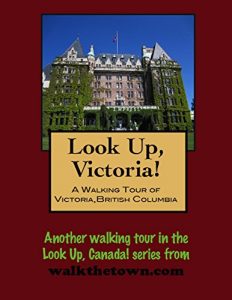
Those years in the economic doldrums meant there was little pressure to replace those crumbling buildings. So the streets are lined with 19th century souvenirs, including North America’s second oldest Chinatown district. We will see many on our walking tour but we will begin at Victoria Inner Harbour at a landmark of more recent vintage...
Each walking tour describes historical and architectural landmarks and provides pictures to help out when those pesky street addresses are missing. Every tour also includes a quick primer on identifying architectural styles seen on Canadian streets.
Vancouver Island is Canada’s most populated island, first settled by the British with a Hudson’s Bay Company post in 1843. It was called Fort Camosack but quickly changed to Fort Victoria. For its first 15 years Victoria was a settlement of only a few hundred frontierspeople dealing in the fur trade. Discovery of gold in the Fraser Canyon in 1858 caused the population to swell into the thousands as Victoria was a convenient port and supply base for prospectors.
Vancouver Island was its own colony in those days and when it was joined with the mainland Colony of British Columbia in 1866 Victoria was made the capital. The mainlanders grumbled about the selection but Victoria has remained the British Columbia capital ever since. The city may have maintained political power but its role as commercial centre of the Canadian Pacific Coast disappeared forever with the arrival of the Canadian Pacific Railway (CPR) in Vancouver in 1886.
The CPR purchased the Canadian Pacific Navigation Company in 1901 and operated ships out of Victoria so the city still attracted its share of ship traffic. In 1919 William Boeing and Eddie Hubbard touched down with a seaplane that kickstarted International Air Mail service and the harbour as a floatplane airport. Victoria Harbour was a busy place during World War II with 25 ships launching from the Victoria Machinery Depot.
By mid-century Western Canada’s oldest city began to show its age. Things started to turn around in the later years of the 1900s when its large stock of Edwardian style buildings came to be considered “charming” and no longer “dilapidating.” Tourism joined government as a major economic engine and in recent years the “Garden City” has become a treasured retirement spot as well.
Those years in the economic doldrums meant there was little pressure to replace those crumbling buildings. So the streets are lined with 19th century souvenirs, including North America’s second oldest Chinatown district. We will see many on our walking tour but we will begin at Victoria Inner Harbour at a landmark of more recent vintage...