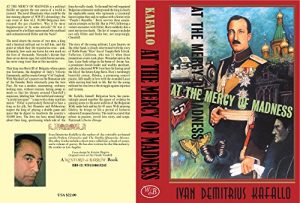
AT THE MERCY OF MADNESS is a political thriller set against the vast canvas of a world in turmoil. The novel illuminates what could be the last missing chapter of WW II’s chronology: the epic event of how ALL 50,000 Bulgarian Jews escaped the gas chambers. Was it by mere happenstance or by some miracle? Or was it engineered by a brilliant mastermind who outfoxed and outmaneuvered Hitler and the Nazis?
The novel charts the stories of two men, a king and a fanatical militant out to kill him, and the point at which their life trajectories cross—and, ultimately, how each one leaves his own mark on the lives of thousands. Nietzsche’s dictum that there are no heroic ages, but solely heroic persons, has never rung truer than in this narrative.
That king was Boris III of Bulgaria whose queen was Giovanna, the daughter of Italy’s Vittorio Emmanuele, and his cousin George VI ofEngland. With Marshal List’s panzers on the Rumanian side of the Danube, Boris reluctantly joins the Axis Pact. He was a modest, unassuming, ordinary looking man, without excesses, hating pomp so much so that his shyness aroused Churchill’s suspicions, labeling him “distrustful and cunning” “a pitiful intriguer” “a man with a slimy reptilian nature.” Hitler is particularly flattered to have a king as his ally, but Himmler and Ribbentrop suspect the king of playing a double game and insist that he deport to Auschwitz the country’s 50,000 Jews. The Jews too have mixed feelings about their king, questioning which side of the
fence he really stands. To the small but well organized Bulgarian communist underground the king is clearly the implacable enemy who represents a tyrannical fascist regime they seek to replace with a Soviet-style “People’s Republic.” Boris survives three assassi- nation attempts on his life. But in 1943, following a violent encounter with Hitler, Boris suddenly dies a most mysterious death. The list of suspects includes not only Hitler and Stalin but, not surprisingly, Churchill.
The story of the young militant, Lazar Insarov, on the other hand, is closely intertwined with the story of Rabbi Haim “Rico”Asa of Temple Beth Tikvah, Fullerton, California, who was 11 when those momentous events took place. Wounded and on the lam, Lazar finds refuge in the home of Avram Asa, a prominent Jewish leader and wealthy merchant, and also a decorated WW I war hero for having saved the life of the future King Boris. Rico’s ravishingly beautiful cousin, Rebeka, a promising concert pianist, falls madly in love with the wounded Lazar while nursing him back to life. But for the young militant his true love is the struggle against injustice and tyranny.
Mr. Kafallo, himself Bulgarian born, has pains- takingly pieced together the jigsaw of evidence by gaining access to the secret archives of the Bulgarian KGB, under lock and key for 45 years. With amazing fidelity, he brings to life a period of hitherto unknown European history. The result is a novel that echoes in passion, torrid love story, and scope, Pasternak’s Doctor Zhivago.
The novel charts the stories of two men, a king and a fanatical militant out to kill him, and the point at which their life trajectories cross—and, ultimately, how each one leaves his own mark on the lives of thousands. Nietzsche’s dictum that there are no heroic ages, but solely heroic persons, has never rung truer than in this narrative.
That king was Boris III of Bulgaria whose queen was Giovanna, the daughter of Italy’s Vittorio Emmanuele, and his cousin George VI ofEngland. With Marshal List’s panzers on the Rumanian side of the Danube, Boris reluctantly joins the Axis Pact. He was a modest, unassuming, ordinary looking man, without excesses, hating pomp so much so that his shyness aroused Churchill’s suspicions, labeling him “distrustful and cunning” “a pitiful intriguer” “a man with a slimy reptilian nature.” Hitler is particularly flattered to have a king as his ally, but Himmler and Ribbentrop suspect the king of playing a double game and insist that he deport to Auschwitz the country’s 50,000 Jews. The Jews too have mixed feelings about their king, questioning which side of the
fence he really stands. To the small but well organized Bulgarian communist underground the king is clearly the implacable enemy who represents a tyrannical fascist regime they seek to replace with a Soviet-style “People’s Republic.” Boris survives three assassi- nation attempts on his life. But in 1943, following a violent encounter with Hitler, Boris suddenly dies a most mysterious death. The list of suspects includes not only Hitler and Stalin but, not surprisingly, Churchill.
The story of the young militant, Lazar Insarov, on the other hand, is closely intertwined with the story of Rabbi Haim “Rico”Asa of Temple Beth Tikvah, Fullerton, California, who was 11 when those momentous events took place. Wounded and on the lam, Lazar finds refuge in the home of Avram Asa, a prominent Jewish leader and wealthy merchant, and also a decorated WW I war hero for having saved the life of the future King Boris. Rico’s ravishingly beautiful cousin, Rebeka, a promising concert pianist, falls madly in love with the wounded Lazar while nursing him back to life. But for the young militant his true love is the struggle against injustice and tyranny.
Mr. Kafallo, himself Bulgarian born, has pains- takingly pieced together the jigsaw of evidence by gaining access to the secret archives of the Bulgarian KGB, under lock and key for 45 years. With amazing fidelity, he brings to life a period of hitherto unknown European history. The result is a novel that echoes in passion, torrid love story, and scope, Pasternak’s Doctor Zhivago.