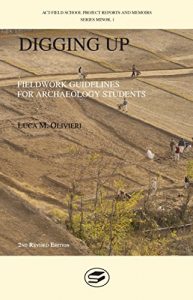
Digging up is a fieldwork guideline for archaeology students. Luca M. Olivieri focuses on the practical issues faced by the students in an archaeological excavation.
The aim of the book is to introduce the student of archaeology to the complex problem of organizing, planning and implementing an excavation campaign. While new technologies are making the archaeologist’s work more standardized and complete, such methods will never replace manual excavation techniques, even when remote sensing technologies are also applied. Excavation and data interpretation remain activities in which the human factor reigns supreme despite all its limits. The capacity to interpret evidence, as well as statistics, is what makes an archaeologist a good professional and so there will always be excavations that are correctly interpreted and others that are interpreted incorrectly. What is important is that there should be good and well documented excavations. This is the aim of this booklet.
The aim of the book is to introduce the student of archaeology to the complex problem of organizing, planning and implementing an excavation campaign. While new technologies are making the archaeologist’s work more standardized and complete, such methods will never replace manual excavation techniques, even when remote sensing technologies are also applied. Excavation and data interpretation remain activities in which the human factor reigns supreme despite all its limits. The capacity to interpret evidence, as well as statistics, is what makes an archaeologist a good professional and so there will always be excavations that are correctly interpreted and others that are interpreted incorrectly. What is important is that there should be good and well documented excavations. This is the aim of this booklet.