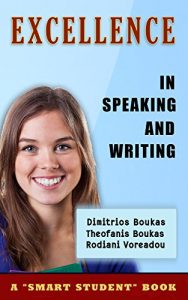
This book addresses two specific delicate issues in the life of students:
1. Many students have an aversion to speaking in front of the class or some other audience; they find it very stressful and even develop a fear of public speaking. The book suggests easy helpful practices, which may resolve the issue completely.
2. Many students struggle with an anxiety about how to fill the page(s) in their compositions, or how to make their compositions pleasant to the reader. The book offers some clever ways to add content and liveliness to a composition.
These two issues can be completely resolved by using the resources contained in this book.
Examples of issues covered in the book:
• I make plans and set goals for the school year, but my plans and goals seem to die off after some time.
• How can I have a strong impact on my listeners when I speak?
• Sometimes my mind is slow, or I cannot concentrate in class.
• I wish I were as flexible, in body and mind, as some of my classmates.
• I do not feel confident enough to stand up and speak to an audience of many people.
• When I begin to speak about something, I feel self conscious and I make a mess.
• I don’t want to speak in public because I am afraid I will forget what I had to say.
• If I have to take oral exams, I become very anxious and paralyze with fear.
• I am afraid my audience will not get the message I want to convey.
• I am not a good speaker.
• When I am on stage, I feel and act very awkward.
• I am slow in writing compositions.
• I cannot put on paper what I have in my mind, in an interesting way.
• My compositions are short and dry.
• I cannot inspire nor motivate anybody with my words.
• How can I attract the attention of my listeners, when I speak?
• I have no zest for writing; compositions are a burden for me.
• When I write, I am poor in ideas and my words are not colorful.
• When I speak, I am poor in ideas and my words are not colorful.
• I am not sure that my audience listens to me when I speak.
• My friends, who read my compositions, tell me that they are excellent. Why am I not getting a high grade?
In the Introduction of the book, we read:
Speaking and writing are common ways of expressing ourselves and communicating information. In their highest level of effectiveness, they can both be extremely powerful means of creating strong impact on the souls and minds of people.
During the school years we have the opportunity to practice them and start developing them into higher levels of quality.
This book contains suggestions that make this practice easy for you, by giving you resources for overcoming boredom, lack of inspiration and low self-confidence. You are also given specific suggestions on how to make your speaking and writing strongly impactful.
You will continue to use most of these resources in your adult life, because of their universal value and applicability.
There is power in speech and power in writing. Start using the means to develop this power now.
To your excellence!
Dimitrios Boukas
1. Many students have an aversion to speaking in front of the class or some other audience; they find it very stressful and even develop a fear of public speaking. The book suggests easy helpful practices, which may resolve the issue completely.
2. Many students struggle with an anxiety about how to fill the page(s) in their compositions, or how to make their compositions pleasant to the reader. The book offers some clever ways to add content and liveliness to a composition.
These two issues can be completely resolved by using the resources contained in this book.
Examples of issues covered in the book:
• I make plans and set goals for the school year, but my plans and goals seem to die off after some time.
• How can I have a strong impact on my listeners when I speak?
• Sometimes my mind is slow, or I cannot concentrate in class.
• I wish I were as flexible, in body and mind, as some of my classmates.
• I do not feel confident enough to stand up and speak to an audience of many people.
• When I begin to speak about something, I feel self conscious and I make a mess.
• I don’t want to speak in public because I am afraid I will forget what I had to say.
• If I have to take oral exams, I become very anxious and paralyze with fear.
• I am afraid my audience will not get the message I want to convey.
• I am not a good speaker.
• When I am on stage, I feel and act very awkward.
• I am slow in writing compositions.
• I cannot put on paper what I have in my mind, in an interesting way.
• My compositions are short and dry.
• I cannot inspire nor motivate anybody with my words.
• How can I attract the attention of my listeners, when I speak?
• I have no zest for writing; compositions are a burden for me.
• When I write, I am poor in ideas and my words are not colorful.
• When I speak, I am poor in ideas and my words are not colorful.
• I am not sure that my audience listens to me when I speak.
• My friends, who read my compositions, tell me that they are excellent. Why am I not getting a high grade?
In the Introduction of the book, we read:
Speaking and writing are common ways of expressing ourselves and communicating information. In their highest level of effectiveness, they can both be extremely powerful means of creating strong impact on the souls and minds of people.
During the school years we have the opportunity to practice them and start developing them into higher levels of quality.
This book contains suggestions that make this practice easy for you, by giving you resources for overcoming boredom, lack of inspiration and low self-confidence. You are also given specific suggestions on how to make your speaking and writing strongly impactful.
You will continue to use most of these resources in your adult life, because of their universal value and applicability.
There is power in speech and power in writing. Start using the means to develop this power now.
To your excellence!
Dimitrios Boukas