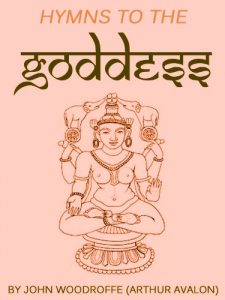
THE Goddess or Devī (as the Hindus call Her) is God (as the Western worshippers address Him) in Its Mother aspect. The latter not uncommonly deem such attribution of feminine quality to be "heathenish"; but this condemnation (for the criticism has, of course, this intendment) is itself singularly foolish in that it is thereby implied that of two sets of terms (neither of which is in its strict sense applicable to the Deity as the Author of forms), one is, in fact, a more correct description than the other. In the Navaratneśvara it is said: "That Devī, who is existence, consciousness, and bliss, should be thought of as a female or as a male, or as pure Brahman. In reality, however, She is neither male nor neuter (that is to say, that She is not bound to any particular form)." No one contends that the Brahmatattva in the supreme abode beyond appearances is masculine as opposed to feminine, or the latter as contrasted with the former. Like all else in this matter, words are but the babbling endeavour of our plane to express that which is above it. It is not easy, then, to explain the condemnation except upon the assumption that those who pronounce it think their mother's sex to be inferior to their own, and that thus Deity is unworthily described by any other terms than those of masculine excellence.
About Author:
Sir John George Woodroffe (1865–1936), also known by his pseudonym Arthur Avalon, was a British Orientalist whose work helped to unleash in the West a deep and wide interest in Hindu philosophy and Yogic practices.
About Author:
Sir John George Woodroffe (1865–1936), also known by his pseudonym Arthur Avalon, was a British Orientalist whose work helped to unleash in the West a deep and wide interest in Hindu philosophy and Yogic practices.