Investment in energy and water efficiency offers the largest and most cost-effective opportunity for
both industrialized and developing nations to limit the enormous financial, health and
environmental costs associated with burning fossil fuels. Available, cost-effective investments in
energy and water efficiency globally are estimated to be tens of billions of dollars per year.
However, the actual investment level is far less, and covers only a small fraction of the existing,
financially-attractive opportunities for energy savings investments.
If all cost-effective efficiency investments were made in U.S. public and commercial buildings,
efficiency project spending would roughly triple, and within a decade would result in savings of
$20 billion per year in energy and water costs, create over 100,000 permanent new jobs and
significantly cut pollution. For developing countries with rapid economic growth and surging
energy consumption, energy and water-efficient design offers a very cost-effective way to control
the exploding costs of building power and water treatment plants, while limiting the expense of
future energy imports and the widespread health and environmental damages and costs that result
from burning fossil fuels.
These efficiency opportunities and their inherent benefits prompted the U.S. Department of Energy
in early 1994 to begin working with industry to develop a consensus approach to measuring and
verifying efficiency investments in order to overcome existing barriers to efficiency. The North
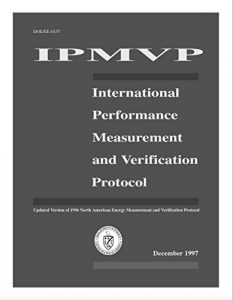
American Measurement and Verification Protocol (NEMVP) was published in March of 1996.
The name reflects the original scope of work, which was to create a document for use in the energy
performance contracting industry in North America. That Protocol contained methodologies that
were compiled by a committee of industry experts and involved hundreds of interested parties,
primarily from the United States, Canada and Mexico. It was intended to provide industry
consensus guidelines that would increase reliability and level of savings, cut efficiency investment
costs and provide standardization required to secure lower cost financing.
Response to the 1996 document has been tremendous. North America’s energy service companies
have adopted the IPMVP/Protocol as the industry standard approach to measurement and
verification (M&V). States ranging from Florida to New York now require use of the IPMVP in
state-level energy efficiency retrofits. The U.S. Federal Government, through the Department of
Energy’s Federal Energy Management Program (FEMP), has built upon the Protocol to put in
place an accelerated program for up to several billion dollars of energy and water retrofits in U.S.
Federal buildings. A growing number of utilities and energy efficiency finance firms require the
use of the Protocol.
both industrialized and developing nations to limit the enormous financial, health and
environmental costs associated with burning fossil fuels. Available, cost-effective investments in
energy and water efficiency globally are estimated to be tens of billions of dollars per year.
However, the actual investment level is far less, and covers only a small fraction of the existing,
financially-attractive opportunities for energy savings investments.
If all cost-effective efficiency investments were made in U.S. public and commercial buildings,
efficiency project spending would roughly triple, and within a decade would result in savings of
$20 billion per year in energy and water costs, create over 100,000 permanent new jobs and
significantly cut pollution. For developing countries with rapid economic growth and surging
energy consumption, energy and water-efficient design offers a very cost-effective way to control
the exploding costs of building power and water treatment plants, while limiting the expense of
future energy imports and the widespread health and environmental damages and costs that result
from burning fossil fuels.
These efficiency opportunities and their inherent benefits prompted the U.S. Department of Energy
in early 1994 to begin working with industry to develop a consensus approach to measuring and
verifying efficiency investments in order to overcome existing barriers to efficiency. The North
American Measurement and Verification Protocol (NEMVP) was published in March of 1996.
The name reflects the original scope of work, which was to create a document for use in the energy
performance contracting industry in North America. That Protocol contained methodologies that
were compiled by a committee of industry experts and involved hundreds of interested parties,
primarily from the United States, Canada and Mexico. It was intended to provide industry
consensus guidelines that would increase reliability and level of savings, cut efficiency investment
costs and provide standardization required to secure lower cost financing.
Response to the 1996 document has been tremendous. North America’s energy service companies
have adopted the IPMVP/Protocol as the industry standard approach to measurement and
verification (M&V). States ranging from Florida to New York now require use of the IPMVP in
state-level energy efficiency retrofits. The U.S. Federal Government, through the Department of
Energy’s Federal Energy Management Program (FEMP), has built upon the Protocol to put in
place an accelerated program for up to several billion dollars of energy and water retrofits in U.S.
Federal buildings. A growing number of utilities and energy efficiency finance firms require the
use of the Protocol.