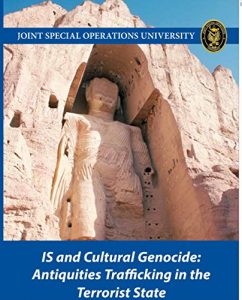
In IS and Cultural Genocide: Antiquities Trafficking in the Terrorist State, the
writing team of Retired Brigadier General Russell Howard, Marc Elliott,
and Jonathan Prohov offer compelling research that reminds government
and military officials of the moral, legal, and ethical dimensions
of protecting cultural antiquities from looting and illegal trafficking.
Internationally, states generally agree on the importance of protecting
antiquities, art, and cultural property not only for their historical and
artistic importance, but also because such property holds economic,
political, and social value for nations and their peoples. Protection is in
the common interest because items or sites are linked to the common
heritage of mankind. The authors make the point that a principle of
international law asserts that cultural or natural elements of humanity’s
common heritage should be protected from exploitation and held in
trust for future generations. The conflicts in Afghanistan, and especially
in Iraq and Syria, coupled with the rise of the Islamic State (IS), have
brought renewed attention to the plight of cultural heritage in the
Middle East and throughout the world.
writing team of Retired Brigadier General Russell Howard, Marc Elliott,
and Jonathan Prohov offer compelling research that reminds government
and military officials of the moral, legal, and ethical dimensions
of protecting cultural antiquities from looting and illegal trafficking.
Internationally, states generally agree on the importance of protecting
antiquities, art, and cultural property not only for their historical and
artistic importance, but also because such property holds economic,
political, and social value for nations and their peoples. Protection is in
the common interest because items or sites are linked to the common
heritage of mankind. The authors make the point that a principle of
international law asserts that cultural or natural elements of humanity’s
common heritage should be protected from exploitation and held in
trust for future generations. The conflicts in Afghanistan, and especially
in Iraq and Syria, coupled with the rise of the Islamic State (IS), have
brought renewed attention to the plight of cultural heritage in the
Middle East and throughout the world.