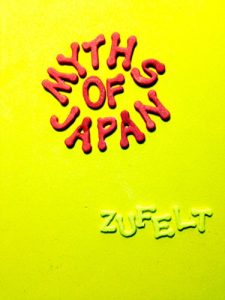
The stories retold here are from the first ninety chapters of the Kojiki (“Record of Ancient Matters”), the oldest compilation of Japanese mythology.
In "Part One: The Age of Gods," we follow the adventures of a host of fascinating entities, including Izanagi and Izanami, the Sun Goddess Amaterasu and her stormy brother Susano-o, the Eight-Headed Dragon of Koshi, the sacred sword Kusanagi, the White Rabbit of Inaba, and the Heavenly Grandchild and his sons Luck-of-the-Sea and Luck-of-the-Mountains.
"Part Two: The Age of Men" begins with the legendary first emperor, Jimmu, who is said to have reigned from 660 to 585 BCE. In the stories that follow, the emperor and his successors engage in bloody battles and rocky love affairs and contend with epidemics, betrayals, rebellions, and unruly deities. We end with the tragic tale of one of Japan’s most revered heroes, Yamato Takeru, son of the twelfth emperor, Keiko (said to have reigned from 71 to 130 CE).
"Myths of Japan" is not a scholarly work (no footnotes!) but a modest and sincere attempt to make these seminal stories, which are so deeply ingrained in Japanese culture, more accessible to the casual reader.
In "Part One: The Age of Gods," we follow the adventures of a host of fascinating entities, including Izanagi and Izanami, the Sun Goddess Amaterasu and her stormy brother Susano-o, the Eight-Headed Dragon of Koshi, the sacred sword Kusanagi, the White Rabbit of Inaba, and the Heavenly Grandchild and his sons Luck-of-the-Sea and Luck-of-the-Mountains.
"Part Two: The Age of Men" begins with the legendary first emperor, Jimmu, who is said to have reigned from 660 to 585 BCE. In the stories that follow, the emperor and his successors engage in bloody battles and rocky love affairs and contend with epidemics, betrayals, rebellions, and unruly deities. We end with the tragic tale of one of Japan’s most revered heroes, Yamato Takeru, son of the twelfth emperor, Keiko (said to have reigned from 71 to 130 CE).
"Myths of Japan" is not a scholarly work (no footnotes!) but a modest and sincere attempt to make these seminal stories, which are so deeply ingrained in Japanese culture, more accessible to the casual reader.