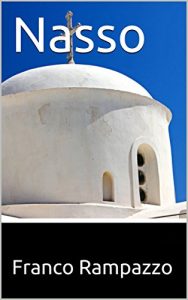
The disaster of September 8, 1943 had taken him by surprise on the Greek island of Naxos, which Italians called Nasso. Nevertheless, by the time he returned to his city of Padua, the Italian soldier Cesare Zanella had cloaked his experiences in silence, an oblivion into which Libero, Cesare's grandson, wants to shine a light some seventy years after those events. This sudden urgency of emotion combines with a re-emergence of his clear memories of his grandfather Cesare, who “played the piano by ear” and led him to discover music by means of those ivory keys. Traveling around Naxos -called also Nasso by Italians- Libero finds a few fleeting traces of his grandfather’s time on the island, thanks in part to the stubborn efforts of a young student who feels inspired by the investigation. Subsequently, their research leads to Pennsylvania, where Libero meets the Greco-American Selene, who becomes the emblematic figure for the entire story. From Selene’s America we go back to a house in the village of Naxos, where the events of war force an unprepared Italian fugitive, an Anglo-German composer of Jewish origin, and a young Greek woman into a close encounter with one another. The war plays out in its fury around the house and on the island itself. But in a surreal atmosphere dominated in the end by piano music, each of the three now living together begins to perceive the humanity of the other. An astonished Libero unearths and weaves a thread between his own life in the present day and the events of the past into a finale–set in Padua in 1968–which he will then have to put into words.
Franco Rampazzo is a professor of Mathematical Analysis at the University of Padua, Italy, and the author of various scientific articles. This is his first novel.
Franco Rampazzo is a professor of Mathematical Analysis at the University of Padua, Italy, and the author of various scientific articles. This is his first novel.