" . . . I believe, then, Smith's story of his rescue by Pocahontas. I have thought it should not be yielded up except on clear disproof of her title to it, and not surrendered to the mere inferences only, far short of conclusive, on which it has been demanded, and which seem rather the outgrowth of unfriendly, if not carping, criticism, than demanded by the facts they are deduced from. . . ."
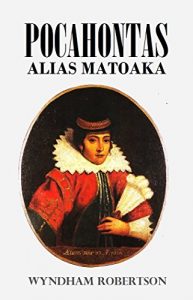
Wyndham Robertson (1803 – 1888) was the Acting Governor of the U.S. state of Virginia from 1836 to 1837. He also served twice in the Virginia House of Delegates, the second time during the American Civil War. In 1887 he published the historical pamphlet "Pocahontas: Alias Matoaka, and Her Descendants."
Pocahontas (born Matoaka, known as Amonute, c. 1596–1617) was a Native American notable for her association with the colonial settlement at Jamestown, Virginia. Pocahontas was the daughter of Powhatan, the paramount chief of a network of tributary tribal nations in the Tsenacommacah, encompassing the Tidewater region of Virginia. In a well-known historical anecdote, she is said to have saved the life of a captive of the Native Americans, the Englishman John Smith, in 1607 by placing her head upon his own when her father raised his war club to execute him.
Captain Argall had with him a large shining copper kettle, which Powhatan thought was a gigantic precious stone. Powhatan admired the kettle immensely, and made several offers to buy it; and at last Argall said that he should have it if he would give him Pocahontas in exchange. The chief joyfully consented, and Pocahontas, who was always glad to be with the English, was taken to their camp.
Pocahontas had not been long with the English before she accepted their customs, and became a Christian. A young officer name John Rolfe, who taught her the English language, attracted by her beauty and by the purity and simplicity of her character, fell in love with her, and she consented to marry him. Powhatan, who was by this time tired of the long warfare in which the palefaces were nearly always victorious, made no objection to the match,' as he foresaw that peace would result from it. The beautiful Indian maiden was married to Captain Rolfe in a rude wooden church which the settlers had built, and after three happy years she accompanied her husband to England in 1616.
Wyndham Robertson (1803 – 1888) was the Acting Governor of the U.S. state of Virginia from 1836 to 1837. He also served twice in the Virginia House of Delegates, the second time during the American Civil War. In 1887 he published the historical pamphlet "Pocahontas: Alias Matoaka, and Her Descendants."
Pocahontas (born Matoaka, known as Amonute, c. 1596–1617) was a Native American notable for her association with the colonial settlement at Jamestown, Virginia. Pocahontas was the daughter of Powhatan, the paramount chief of a network of tributary tribal nations in the Tsenacommacah, encompassing the Tidewater region of Virginia. In a well-known historical anecdote, she is said to have saved the life of a captive of the Native Americans, the Englishman John Smith, in 1607 by placing her head upon his own when her father raised his war club to execute him.
Captain Argall had with him a large shining copper kettle, which Powhatan thought was a gigantic precious stone. Powhatan admired the kettle immensely, and made several offers to buy it; and at last Argall said that he should have it if he would give him Pocahontas in exchange. The chief joyfully consented, and Pocahontas, who was always glad to be with the English, was taken to their camp.
Pocahontas had not been long with the English before she accepted their customs, and became a Christian. A young officer name John Rolfe, who taught her the English language, attracted by her beauty and by the purity and simplicity of her character, fell in love with her, and she consented to marry him. Powhatan, who was by this time tired of the long warfare in which the palefaces were nearly always victorious, made no objection to the match,' as he foresaw that peace would result from it. The beautiful Indian maiden was married to Captain Rolfe in a rude wooden church which the settlers had built, and after three happy years she accompanied her husband to England in 1616.