Foreword by Professor Tim Coelli
It is a pleasure for me to provide a foreword for this book. It has long been acknowledged that traditional measures of organisational performance, such as unit costs, profitability and return on assets, are generally very useful indicators. However, in some instances they are not always informative. For example, a supermarket in one city could face lower input prices (e.g. in rent and wages) relative to one in another city, and hence may have lower unit costs but need not necessarily be more “efficient”. Furthermore, in some organisations output prices are not defined. For example, what is the price of a research paper in a university or the price of an arrest by a police officer? In these instances, it is not clear how one can calculate profitability or return on assets.
This is where the methods described in this book can prove valuable. If one has access to data on the inputs and outputs of a number of similar organisational units, one can use production frontier methods, such as the data envelopment analysis (DEA) method described in this book, to produce performance measures which can accommodate these situations. These methods can be applied to industries that utilise multiple inputs in producing multiple outputs, and hence can be used in a wide variety of settings. This book focuses on applications to service industries, though the methods can also be applied to other industries as well.
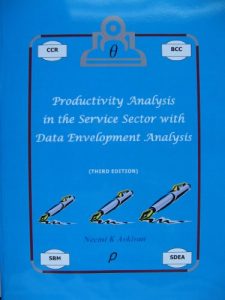
The key advantage of the second edition was that it had been written for the practitioner as opposed to the academic. This is carried forward into the third edition of the book in Parts I-III. Hence, the current edition continues to provide an excellent, non-threatening way for practitioners from industry and government to be able to gain knowledge on DEA methods without being inundated with large amounts of complex mathematics, which tend to be found in much of the academic literature on this topic.
Nevertheless, the third edition is a significant expansion on the second edition with new Parts IV, V and VI. In Part IV, the authors discuss some of the technical problems with DEA that may be overlooked by some users and suggest some possible solutions. In Part V the book addresses some of the more advanced concepts of DEA likely to be of more interest to the academics. Similarly, Part VI also provides material for those who may wish to teach DEA.
Overall, this is a very well set out book that should inspire readers to “jump in and get their hands dirty” in constructing DEA models relevant to the industries in which they operate, allowing them to obtain a range of new insights so as to help them better measure and analyse performance in their organisations.
It is a pleasure for me to provide a foreword for this book. It has long been acknowledged that traditional measures of organisational performance, such as unit costs, profitability and return on assets, are generally very useful indicators. However, in some instances they are not always informative. For example, a supermarket in one city could face lower input prices (e.g. in rent and wages) relative to one in another city, and hence may have lower unit costs but need not necessarily be more “efficient”. Furthermore, in some organisations output prices are not defined. For example, what is the price of a research paper in a university or the price of an arrest by a police officer? In these instances, it is not clear how one can calculate profitability or return on assets.
This is where the methods described in this book can prove valuable. If one has access to data on the inputs and outputs of a number of similar organisational units, one can use production frontier methods, such as the data envelopment analysis (DEA) method described in this book, to produce performance measures which can accommodate these situations. These methods can be applied to industries that utilise multiple inputs in producing multiple outputs, and hence can be used in a wide variety of settings. This book focuses on applications to service industries, though the methods can also be applied to other industries as well.
The key advantage of the second edition was that it had been written for the practitioner as opposed to the academic. This is carried forward into the third edition of the book in Parts I-III. Hence, the current edition continues to provide an excellent, non-threatening way for practitioners from industry and government to be able to gain knowledge on DEA methods without being inundated with large amounts of complex mathematics, which tend to be found in much of the academic literature on this topic.
Nevertheless, the third edition is a significant expansion on the second edition with new Parts IV, V and VI. In Part IV, the authors discuss some of the technical problems with DEA that may be overlooked by some users and suggest some possible solutions. In Part V the book addresses some of the more advanced concepts of DEA likely to be of more interest to the academics. Similarly, Part VI also provides material for those who may wish to teach DEA.
Overall, this is a very well set out book that should inspire readers to “jump in and get their hands dirty” in constructing DEA models relevant to the industries in which they operate, allowing them to obtain a range of new insights so as to help them better measure and analyse performance in their organisations.