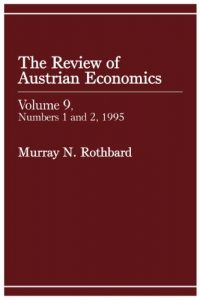
RAE VOLUME 9
Murray Rothbard had long dreamed of an Austrian academic journal. In 1986, his dream came true. The Mises Institute published it, and it changed everything. The Austrians could focus on internal development, highlight the contrast with the mainstream, and show their wares to the profession and the world at large.
Rothbard was an exacting editor, and results are spectacular and historic.
The individual issues have been nearly impossible to find, until now. Today you can own the entire set, learn from the pioneering articles that Murray and his co-editors saw as crucial, and see what gave the modern Austrian movement its scholarly momentum.
I.Articles
Jörg Guido Hülsmann
1.Free Banking and the Free Bankers
Salim Rashid and Abdus Samad
2.Portfolio Management of the Free Banks of Illinois:An Examination of Historical Allegations
Walter Block and Kenneth M. Garschina
3.Hayek, Business Cycles and Fractional Reserve Banking:Continuing the De-Homogenization Process
Pascal Salin
4.The Myth of the Income Effect
Anthony de Jasay
5.Hayek: Some Missing Pieces
David W. Boyd
6.Vertical Restraints and the Retail Free Riding Problem:An Austrian Perspective
II.Notes and Replies
Leland B. Yeager
7.Rejoinder: Salerno on Calculation, Knowledge, and Appraisement
Joseph T. Salerno
8.A Final Word: Calculation, Knowledge, and Appraisement
Hans-Hermann Hoppe
9.Socialism: A Property or Knowledge Problem?
Jeffrey M. Herbener
10.Calculation and the Question of Arithmetic
III.Review Essays
Roger W. Garrison
11.Keynes Was a Keynesian
Murray N. Rothbard
12.Intimidation by Rhetoric
IV.Book Review
13.Murray N. Rothbard, Economic Thought Before Adam Smith (vol. I) and Classical Economics (vol. II)Reviewed by Leland B. Yeager
Dedicated to the Memory of Murray N. Rothbard
From the Editors
Peter G. Klein
1.Economic Calculation and the Limits of Organization
Pascal Salin
2.Cartels as Efficient Productive Structures
Murray Rothbard had long dreamed of an Austrian academic journal. In 1986, his dream came true. The Mises Institute published it, and it changed everything. The Austrians could focus on internal development, highlight the contrast with the mainstream, and show their wares to the profession and the world at large.
Rothbard was an exacting editor, and results are spectacular and historic.
The individual issues have been nearly impossible to find, until now. Today you can own the entire set, learn from the pioneering articles that Murray and his co-editors saw as crucial, and see what gave the modern Austrian movement its scholarly momentum.
I.Articles
Jörg Guido Hülsmann
1.Free Banking and the Free Bankers
Salim Rashid and Abdus Samad
2.Portfolio Management of the Free Banks of Illinois:An Examination of Historical Allegations
Walter Block and Kenneth M. Garschina
3.Hayek, Business Cycles and Fractional Reserve Banking:Continuing the De-Homogenization Process
Pascal Salin
4.The Myth of the Income Effect
Anthony de Jasay
5.Hayek: Some Missing Pieces
David W. Boyd
6.Vertical Restraints and the Retail Free Riding Problem:An Austrian Perspective
II.Notes and Replies
Leland B. Yeager
7.Rejoinder: Salerno on Calculation, Knowledge, and Appraisement
Joseph T. Salerno
8.A Final Word: Calculation, Knowledge, and Appraisement
Hans-Hermann Hoppe
9.Socialism: A Property or Knowledge Problem?
Jeffrey M. Herbener
10.Calculation and the Question of Arithmetic
III.Review Essays
Roger W. Garrison
11.Keynes Was a Keynesian
Murray N. Rothbard
12.Intimidation by Rhetoric
IV.Book Review
13.Murray N. Rothbard, Economic Thought Before Adam Smith (vol. I) and Classical Economics (vol. II)Reviewed by Leland B. Yeager
Dedicated to the Memory of Murray N. Rothbard
From the Editors
Peter G. Klein
1.Economic Calculation and the Limits of Organization
Pascal Salin
2.Cartels as Efficient Productive Structures