FOREWORD
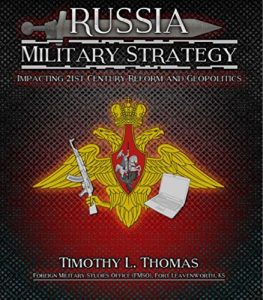
For the past ten years, as Prime Minister and President, Vladimir Putin has led an extensive reorganization and reequipping of his country’s armed forces. Further, he has taken several opportunities to reclaim Russian territory that was taken, from his perspective, illegally. This book describes Putin and the military’s use of various strategic concepts, the Defense Ministry’s new equipment and reform initiatives, and Putin’s geopolitical quest for influence in the Arctic and Ukraine. Included in the discussion are some of the unintended consequences of his actions (negative world opinion, sanctions, NATO responses, etc.).
The book is divided into three parts. Part One, Strategy, has three chapters. They discuss President Putin’s personality and background that drive his thinking, especially his mistrust of the West; Russia’s military concept of strategy; and Russia’s use of indirect, asymmetric, and non-military actions. Part Two, Future War, has four chapters. They discuss the armed forces new equipment, new forces (the Aerospace Forces in particular), and there is an extended discussion of future war and cyber age thinking and adjustments. Part Three, Geopolitics, has two chapters. One details Russia’s Arctic activities and the second describes the methods used to take Crimea and occupy parts of Eastern Ukraine. Potential future uses of Russia’s armed forces are described in the conclusions.
The book supplements the author’s prior work titled Recasting the Red Star. It should serve as a welcome addition to the shelves of those seeking an understanding of Russia’s military strategy, reform, and geopolitical thought.
Thomas Wilhelm
Director, Foreign Military Studies Office
2015
For the past ten years, as Prime Minister and President, Vladimir Putin has led an extensive reorganization and reequipping of his country’s armed forces. Further, he has taken several opportunities to reclaim Russian territory that was taken, from his perspective, illegally. This book describes Putin and the military’s use of various strategic concepts, the Defense Ministry’s new equipment and reform initiatives, and Putin’s geopolitical quest for influence in the Arctic and Ukraine. Included in the discussion are some of the unintended consequences of his actions (negative world opinion, sanctions, NATO responses, etc.).
The book is divided into three parts. Part One, Strategy, has three chapters. They discuss President Putin’s personality and background that drive his thinking, especially his mistrust of the West; Russia’s military concept of strategy; and Russia’s use of indirect, asymmetric, and non-military actions. Part Two, Future War, has four chapters. They discuss the armed forces new equipment, new forces (the Aerospace Forces in particular), and there is an extended discussion of future war and cyber age thinking and adjustments. Part Three, Geopolitics, has two chapters. One details Russia’s Arctic activities and the second describes the methods used to take Crimea and occupy parts of Eastern Ukraine. Potential future uses of Russia’s armed forces are described in the conclusions.
The book supplements the author’s prior work titled Recasting the Red Star. It should serve as a welcome addition to the shelves of those seeking an understanding of Russia’s military strategy, reform, and geopolitical thought.
Thomas Wilhelm
Director, Foreign Military Studies Office
2015