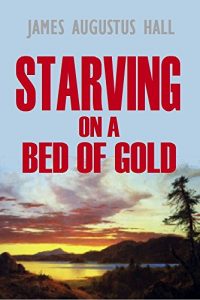
James Augustus Hall was a San Francisco lawyer who in 1900 contracted "gold fever" and voyaged to the Alaska goldfields of the Seward Peninsula. In 1909, Hall published a book of his experiences in Alaska titled "Starving on a Bed of Gold."
The experience of James A. Hall in Alaska's Seward Peninsual, as related in his book, "Starving on a Bed of Gold," is so remarkable that many people will no doubt find it difficult to believe that anyone could survive such suffering and hardships and be able to tell the story.
On July 15th 1900, he left the then town of Teller, on Port Clarence Bay, Alaska, with two other men, to go on a three days' gold prospecting trip in the mountains, near the Arctic Ocean. Hall was separated on the top of a high, rough mountain, in a dense fog from the others and became lost. He had been all but given him up for dead many weeks before he was finally rescued and brought into a hotel, in Teller (about seven miles from the town he left) on or about September 26th, 1900. Mr. Hall did not have as much as three pounds of food left when he was separated and had no compass, gun or fishing apparatus.
The reason given for this 3-day prospecting tour is related by Hall as follows:
"These men, it seems, claimed they had information, derived from the deathbed statement of some old friend of one of them in Florida, concerning the location of a very rich quartz prospect at some point a few miles back in the mountains north of Teller. It was asserted that this man was one of the first party of surveyors sent into Alaska by the United States government, many years ago. He had discovered this rich lode, but had no opportunity to prospect it. He had kept the information to himself, hoping at some time to come out and locate it but one thing or another detained him until he found himself near the top of the "Great Divide" that we must all cross, sooner or later. He then communicated the information to others, and it fell into the hands of one of these two men."
In describing his rescue, Hall writes:
"I had wandered for sixty-seven days over the roughest part of wild Alaska without food, without hearing a human voice, literally almost without hope. I had now resigned myself to death, and, silently, awaited the approach of the grim monster; he was but a few short hours behind his prey; I could feel the chill of his clammy claws; his enveloping saliva, such as a snake is said to emit over the body of the frog before it swallows it, was fast covering me; I could indistinctly hear the muffled oars of his boatman, Charon, as he made ready to effect a landing and take another solitary passenger to the side of the Great Majority. Then to know that help was at hand, and life once more before me was certainly an indescribable feeling."
Contents
I. THE START
II. AN EXCITING TRIP THROUGH THE ICE.
III. LOST
IV. STRUGGLING HOMEWARD.
V. IN THE HANDS OF FRIENDS.
VI. A TERRIBLE WINTER.
VII. TERRIBLE EXPERIENCE OF THREE PROSPECTORS.
VIII. THE ESKIMO.
IX. ALASKAN SENSE AND NONSENSE.
X. THE DISTRICTS ADJACENT TO NOME AND TELLER.
The experience of James A. Hall in Alaska's Seward Peninsual, as related in his book, "Starving on a Bed of Gold," is so remarkable that many people will no doubt find it difficult to believe that anyone could survive such suffering and hardships and be able to tell the story.
On July 15th 1900, he left the then town of Teller, on Port Clarence Bay, Alaska, with two other men, to go on a three days' gold prospecting trip in the mountains, near the Arctic Ocean. Hall was separated on the top of a high, rough mountain, in a dense fog from the others and became lost. He had been all but given him up for dead many weeks before he was finally rescued and brought into a hotel, in Teller (about seven miles from the town he left) on or about September 26th, 1900. Mr. Hall did not have as much as three pounds of food left when he was separated and had no compass, gun or fishing apparatus.
The reason given for this 3-day prospecting tour is related by Hall as follows:
"These men, it seems, claimed they had information, derived from the deathbed statement of some old friend of one of them in Florida, concerning the location of a very rich quartz prospect at some point a few miles back in the mountains north of Teller. It was asserted that this man was one of the first party of surveyors sent into Alaska by the United States government, many years ago. He had discovered this rich lode, but had no opportunity to prospect it. He had kept the information to himself, hoping at some time to come out and locate it but one thing or another detained him until he found himself near the top of the "Great Divide" that we must all cross, sooner or later. He then communicated the information to others, and it fell into the hands of one of these two men."
In describing his rescue, Hall writes:
"I had wandered for sixty-seven days over the roughest part of wild Alaska without food, without hearing a human voice, literally almost without hope. I had now resigned myself to death, and, silently, awaited the approach of the grim monster; he was but a few short hours behind his prey; I could feel the chill of his clammy claws; his enveloping saliva, such as a snake is said to emit over the body of the frog before it swallows it, was fast covering me; I could indistinctly hear the muffled oars of his boatman, Charon, as he made ready to effect a landing and take another solitary passenger to the side of the Great Majority. Then to know that help was at hand, and life once more before me was certainly an indescribable feeling."
Contents
I. THE START
II. AN EXCITING TRIP THROUGH THE ICE.
III. LOST
IV. STRUGGLING HOMEWARD.
V. IN THE HANDS OF FRIENDS.
VI. A TERRIBLE WINTER.
VII. TERRIBLE EXPERIENCE OF THREE PROSPECTORS.
VIII. THE ESKIMO.
IX. ALASKAN SENSE AND NONSENSE.
X. THE DISTRICTS ADJACENT TO NOME AND TELLER.