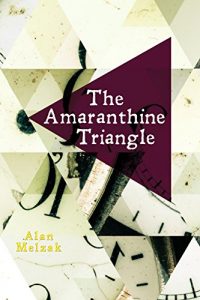
The Aramanthine Triangle:
Parallel worlds occupying the same space but separated from each other by displacements in Time.
Roy and Melissa seem ideally suited. And then Roy becomes obsessed with a young woman that he has never met. Objects and incidents constantly remind him of her. She appears to him in a recurring dream. Her name is Amy, or sometimes Amelia.
His knowledge of her comes from an after-dinner story told by Dr Clair. Clair’s account explains the disappearance of a fellow-student thirty years ago, while knocking on doors, selling Christmas cards: he had stayed with the woman he loved. Her name was Amy.
And seventy years earlier in the house, a doctor seduces the young wife of a close friend. The husband is enraged. He takes a pistol from a bureau, they are in the drawing room. A scuffle breaks out, they struggle for the pistol. There is a shot, someone is hit – but which of them is unknown
An oil painting hangs on the wall by the piano. A portrait of Amelia. She is the very image of the wife.
An unresolved love affair endlessly repeated, frozen in Time.
Synopsis:
Roy and Melissa are ideally suited, that is, until Roy becomes obsessed with a young woman who figures in a recurring dream. He seems to see Amy everywhere, and objects and incidents constantly remind him of her. Then he recognizes her in an after-dinner story told by Dr Clair. Realizing that Amy might be something more than merely a figment of his dream, he goes to the house described in the story in search of her.
The storyline runs through four "time-frames": distant past (1899), the past (1947), recent past (1959) and the present (1989).
The central characters and key incidents depicted in each "time displacement" are very much the same. Each phase, in the main, is a repetition of what has gone before, in which the characters are forced to re-enact the same event, more or less. There are necessarily some changes - taking into account the changes in the outside world - but the major difference in each "frame" is the swapping of roles between the main players.
It is as though the key tragic event is frozen in time, endlessly repeating itself because it is unresolved.
In 1889 a doctor seduces the wife of his best friend. It leads to a fight between them, in which they struggle for a pistol. There is a shot, someone is hit - but which of them is unknown. This takes place in the drawing room of a London house.
In 1959 Rick Grant, a medical student, enters the house, owned by Matthew and Amy Stanton. The Stantons seem to be the married couple of the first "time frame", unaged since 1889. What appears to be a re-enactment of the event, takes place - again without a known resolution. But the roles are reversed: Rick takes over from Matthew as the husband.
We learn that in 1948 a psychiatrist (consulted by the Stantons) had a similar experience.
In 1989, Roy enters the house, to be joined, eventually, by Melissa. She seems to become Amy and Roy becomes Matthew - though we are never sure - while in the "real" world outside, Matthew and Amy take on the lives of Roy and Melissa, accepted as such by their friends, apparently unaware of their substitution by these two "strangers".
But the story is open-ended: the underlying impression is that sooner or later the characters will once more be sucked into the same whirlpool of endless repetition without resolution.
Three of the characters involved each have their own explanation of the mysterious events.
Dr John Clair: A man who has experienced deja vus, a sense of having lived before, he believes the events are a convincing example of reincarnation.
Evan Lapwing: A writer of pseudo-scientific books, his opinion has a mechanistic slant: The idea of parallel worlds - occupying the same space but separated by displacements in time. Sometimes two parallel worlds collide when some powerful emotional force linking people from each crosses the dimension of time. Such "c
Parallel worlds occupying the same space but separated from each other by displacements in Time.
Roy and Melissa seem ideally suited. And then Roy becomes obsessed with a young woman that he has never met. Objects and incidents constantly remind him of her. She appears to him in a recurring dream. Her name is Amy, or sometimes Amelia.
His knowledge of her comes from an after-dinner story told by Dr Clair. Clair’s account explains the disappearance of a fellow-student thirty years ago, while knocking on doors, selling Christmas cards: he had stayed with the woman he loved. Her name was Amy.
And seventy years earlier in the house, a doctor seduces the young wife of a close friend. The husband is enraged. He takes a pistol from a bureau, they are in the drawing room. A scuffle breaks out, they struggle for the pistol. There is a shot, someone is hit – but which of them is unknown
An oil painting hangs on the wall by the piano. A portrait of Amelia. She is the very image of the wife.
An unresolved love affair endlessly repeated, frozen in Time.
Synopsis:
Roy and Melissa are ideally suited, that is, until Roy becomes obsessed with a young woman who figures in a recurring dream. He seems to see Amy everywhere, and objects and incidents constantly remind him of her. Then he recognizes her in an after-dinner story told by Dr Clair. Realizing that Amy might be something more than merely a figment of his dream, he goes to the house described in the story in search of her.
The storyline runs through four "time-frames": distant past (1899), the past (1947), recent past (1959) and the present (1989).
The central characters and key incidents depicted in each "time displacement" are very much the same. Each phase, in the main, is a repetition of what has gone before, in which the characters are forced to re-enact the same event, more or less. There are necessarily some changes - taking into account the changes in the outside world - but the major difference in each "frame" is the swapping of roles between the main players.
It is as though the key tragic event is frozen in time, endlessly repeating itself because it is unresolved.
In 1889 a doctor seduces the wife of his best friend. It leads to a fight between them, in which they struggle for a pistol. There is a shot, someone is hit - but which of them is unknown. This takes place in the drawing room of a London house.
In 1959 Rick Grant, a medical student, enters the house, owned by Matthew and Amy Stanton. The Stantons seem to be the married couple of the first "time frame", unaged since 1889. What appears to be a re-enactment of the event, takes place - again without a known resolution. But the roles are reversed: Rick takes over from Matthew as the husband.
We learn that in 1948 a psychiatrist (consulted by the Stantons) had a similar experience.
In 1989, Roy enters the house, to be joined, eventually, by Melissa. She seems to become Amy and Roy becomes Matthew - though we are never sure - while in the "real" world outside, Matthew and Amy take on the lives of Roy and Melissa, accepted as such by their friends, apparently unaware of their substitution by these two "strangers".
But the story is open-ended: the underlying impression is that sooner or later the characters will once more be sucked into the same whirlpool of endless repetition without resolution.
Three of the characters involved each have their own explanation of the mysterious events.
Dr John Clair: A man who has experienced deja vus, a sense of having lived before, he believes the events are a convincing example of reincarnation.
Evan Lapwing: A writer of pseudo-scientific books, his opinion has a mechanistic slant: The idea of parallel worlds - occupying the same space but separated by displacements in time. Sometimes two parallel worlds collide when some powerful emotional force linking people from each crosses the dimension of time. Such "c