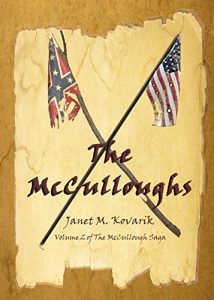
Beau and Stuart McCullough have survived the first years of the American Civil War. Stuart has found his true destiny—vastly unlike the destiny to which he was born—is made complicated when he finally accepts that in order to pursue it he must do so as part of the Confederacy, his political and ideological enemy. His wife, Sarah, has had to abandon her Quaker upbringing and experiences an epiphany when she realizes that her work as an Underground Railroad conductor is not the ideal resolution to slavery that she once thought it was. Stuart and Sarah, along with their surrogate family, must cope with the hardships and near-starvation life that grips the whole of the South. His identical twin, Beau continues to fight for the Confederacy, even though the circumstances he encounters compel him to question his commitment to The Cause. But he fights on, hoping that his perseverance will be the catalyst through which his destiny will be revealed to him. When Beau finally understands where his true destiny lies, it is seemingly wrenched from him while, at the same time, the Civil War draws to its dramatic end and strands him far from his home, from his love, and with no means of survival. Their family plantation, Storm Haven, in DeKalb County, Georgia, is ravaged by the war that has come to its doorstep, and those who have been entrusted with its care are faced with a day-to-day struggle to maintain it. The McCulloughs, like The Brothers, includes interesting, and perhaps little known historical facts about the American Civil War that are used as the foundation of this poignant conclusion of the tale of identical twins, their family, their home, the loves of their lives, their friends, and their unique bond of twinship that was tried, tested, and then re-forged in fire.
This work is based on almost 60 years of the author’s passion for the Civil War and is the result of 40+ years of research, reading, and hours spent in libraries (including local libraries such as the one in Cedar Key, FL). The story is rich in dialogue, with historical fact woven into the fabric of the fictional tale, and is enriched with stirring battle scenes. The McCulloughs also brings more life to the saga’s secondary characters. As a novel, it provides interesting characters of varying social classes who embody the realities of the time period, offers humor that is in counterpoint to the poignancy of the era, and takes a frank, real look at the lives of slaves, without the sugarcoating of watermelon-eating and happy-go-lucky banjo-playing. The book contains moderate to graphic descriptions of battles and depictions of the harshness of battlefield hospitals, and includes limited, mild adult language. Sexual content is minimal and restricted to soft innuendo and veiled references (this is a book that your grandmother can read and not even blush!). It is a book that is acceptable reading for teenagers who have an interest in Civil War history and can read at a high school junior/senior level. Last, it is definitely not a “bodice-ripper” novel and is intended for anyone who enjoys a good, well-researched, well-written novel.
This work is based on almost 60 years of the author’s passion for the Civil War and is the result of 40+ years of research, reading, and hours spent in libraries (including local libraries such as the one in Cedar Key, FL). The story is rich in dialogue, with historical fact woven into the fabric of the fictional tale, and is enriched with stirring battle scenes. The McCulloughs also brings more life to the saga’s secondary characters. As a novel, it provides interesting characters of varying social classes who embody the realities of the time period, offers humor that is in counterpoint to the poignancy of the era, and takes a frank, real look at the lives of slaves, without the sugarcoating of watermelon-eating and happy-go-lucky banjo-playing. The book contains moderate to graphic descriptions of battles and depictions of the harshness of battlefield hospitals, and includes limited, mild adult language. Sexual content is minimal and restricted to soft innuendo and veiled references (this is a book that your grandmother can read and not even blush!). It is a book that is acceptable reading for teenagers who have an interest in Civil War history and can read at a high school junior/senior level. Last, it is definitely not a “bodice-ripper” novel and is intended for anyone who enjoys a good, well-researched, well-written novel.