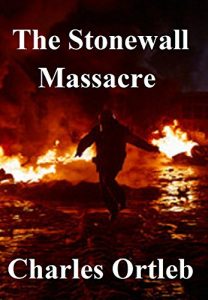
"The Stonewall Massacre" is one of the most entertaining and provocative fictional works of alternate history ever written. This gripping 54-page story asks the politically explosive question, "What if the gay movement had been completely destroyed at its moment of birth in 1969?"
The visionary tale is told from the perspective of a gay waiter who happens to leave the famous Stonewall Inn, a gay bar located in Greenwich Village, just minutes before a police raid on a hot night in June. What happens in this imagined version of the Stonewall riots is a terrifying nightmare of violence and repression which results in the gay community permanently retreating into the shadows without any hopes of ever achieving any form of civil rights.
Ortleb captures perfectly the sinister glee of the conservative forces in psychology, religion, and the media who are only too willing to collaborate in the permanent suppression of a hated and feared sexual minority.
The second part of "The Stonewall Massacre" is where things get really wild. Set in 1982, at a time when the world is completely free of out-of-the-closet homosexuals, it describes the outbreak of a strange illness which first strikes women who are feminists. The disease is first perceived to be a kind of chronic fatigue syndrome, but as doctors study the women more, they describe it as "acquired immunodeficiency syndrome (AIDS)." As AIDS begins to break out in women who are not feminists and in men and children, they realize that AIDS is not just a feminist disease. All the forces in government and science are quickly marshalled to deal with what was initially thought to be a form of chronic fatigue.
Basically, Ortleb has cleverly used a brilliant fictional premise to ask the disturbing question, "Would there have been what we think of as the AIDS epidemic in America if there was no visible gay community and would the medical establishment have realized that chronic fatigue syndrome and other mysterious illnesses are actually forms of AIDS if gay people were essentially invisible?"
A story that at first fictionalizes the total destruction of the gay community evolves into a string of troubling questions about politics, science, and the ability of medical authorities to control the information about epidemics.
There has never been an alternate fictional history quite like this. Ortleb's uncanny narrative invention is fast-paced, darkly hilarious, and infused with great philosophical intelligence as well as journalistic knowledge. "The Stonewall Massacre" is more than just literary fun. This is the rare alternate history that has the potential to actually alter history.
Charles Ortleb was one of the most important journalists of the twentieth century. As the publisher and editor-in-chief of New York Native, he pioneered the coverage of the AIDS, HHV-6 and Chronic Fatigue Syndrome epidemics. Rolling Stone said Ortleb's newspaper deserved a Pulitzer Prize. His book, Truth to Power, is considered to be the definitive history of AIDS, HHV-6, and Chronic Fatigue Syndrome.
The visionary tale is told from the perspective of a gay waiter who happens to leave the famous Stonewall Inn, a gay bar located in Greenwich Village, just minutes before a police raid on a hot night in June. What happens in this imagined version of the Stonewall riots is a terrifying nightmare of violence and repression which results in the gay community permanently retreating into the shadows without any hopes of ever achieving any form of civil rights.
Ortleb captures perfectly the sinister glee of the conservative forces in psychology, religion, and the media who are only too willing to collaborate in the permanent suppression of a hated and feared sexual minority.
The second part of "The Stonewall Massacre" is where things get really wild. Set in 1982, at a time when the world is completely free of out-of-the-closet homosexuals, it describes the outbreak of a strange illness which first strikes women who are feminists. The disease is first perceived to be a kind of chronic fatigue syndrome, but as doctors study the women more, they describe it as "acquired immunodeficiency syndrome (AIDS)." As AIDS begins to break out in women who are not feminists and in men and children, they realize that AIDS is not just a feminist disease. All the forces in government and science are quickly marshalled to deal with what was initially thought to be a form of chronic fatigue.
Basically, Ortleb has cleverly used a brilliant fictional premise to ask the disturbing question, "Would there have been what we think of as the AIDS epidemic in America if there was no visible gay community and would the medical establishment have realized that chronic fatigue syndrome and other mysterious illnesses are actually forms of AIDS if gay people were essentially invisible?"
A story that at first fictionalizes the total destruction of the gay community evolves into a string of troubling questions about politics, science, and the ability of medical authorities to control the information about epidemics.
There has never been an alternate fictional history quite like this. Ortleb's uncanny narrative invention is fast-paced, darkly hilarious, and infused with great philosophical intelligence as well as journalistic knowledge. "The Stonewall Massacre" is more than just literary fun. This is the rare alternate history that has the potential to actually alter history.
Charles Ortleb was one of the most important journalists of the twentieth century. As the publisher and editor-in-chief of New York Native, he pioneered the coverage of the AIDS, HHV-6 and Chronic Fatigue Syndrome epidemics. Rolling Stone said Ortleb's newspaper deserved a Pulitzer Prize. His book, Truth to Power, is considered to be the definitive history of AIDS, HHV-6, and Chronic Fatigue Syndrome.